

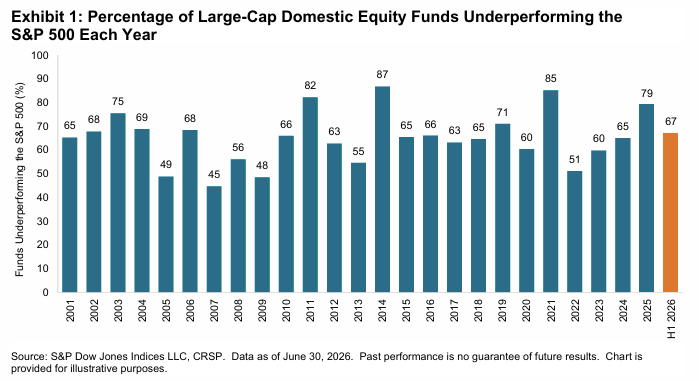
It remains tough to generate stock market returns that beat (or outperform) a passively managed fund tracking the S&P 500.
According to new data from S&P Dow Jones Indices (SPDJI), just a third of U.S. large-cap equity fund managers outperformed the S&P 500’s 10% gain in the first half of 2026.
“Compared with recent years, active managers faced a more supportive market backdrop, characterized by broader participation and stronger performance outside the largest stocks,” SPDJI analysts led by Anu Ganti wrote. “In our largest and most closely watched comparison, 67% of all active large-cap U.S. equity funds underperformed the S&P 500. It was an improvement from the 79% rate observed over full-year 2025, but these seemingly favorable conditions were still not enough for most managers to capitalize on.“
Indeed, more stocks have been moving independently of each other. But as we discussed in July, just because market conditions increasingly favor stock pickers doesn’t mean more stock pickers are beating the market.
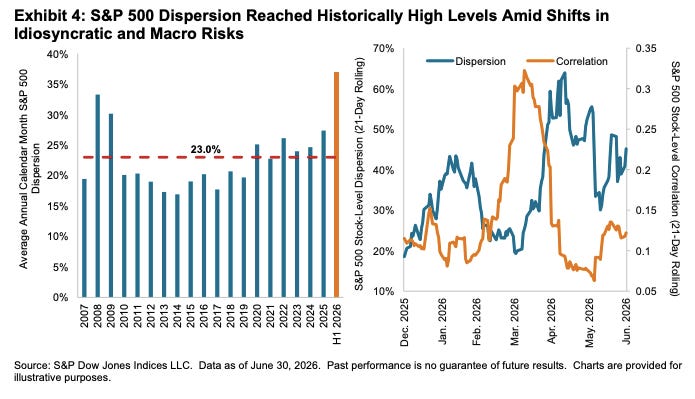
Here’s more on that from SPDJI’s report: “Conditions for stock selection were generally auspicious, but active managers had to contend with a shifting volatility landscape. Dispersion rose during the first two months of the year, however, idiosyncratic risks took a backseat to macro risks in March, as investors shifted their focus away from SaaS apocalypse fears and toward the war with Iran. Dispersion declined and stock-level correlations rose accordingly. Subsequently, easing geopolitical concerns and increased scrutiny faced by companies during the Q1 earnings season contributed to the return of company-level risk and a sharp rise in dispersion. The prospects for stock pickers in large-cap U.S. equities were most pronounced during May 2026, when S&P 500 rolling 21-day dispersion reached a high of 64%.”
We’re now on track for a 17th consecutive year in which the majority of fund managers in this category have lagged the index.
This is probably assumed. But as you stretch the time horizon, the numbers get even more dismal. Over three years, 77% underperformed the S&P 500. Over five years, 89% underperformed. And over 20 years, 93% underperformed.
To be fair, the goal of every fund manager and investor isn’t necessarily to beat some benchmark. Nevertheless, for active investors, seeing a low-cost index fund consistently outperforming may be disheartening.
Past performance is no guarantee of future results 📉
It’s great if you or your fund manager have generated industry-leading performance in recent periods. However, outperformers rarely continue to outperform.