

Oil prices have been volatile amid war in Iran and disruption in the Strait of Hormuz.
On Monday, prices for WTI crude — the benchmark for oil sold in the U.S. — and Brent crude — the benchmark for oil sold in Europe — both briefly spiked to nearly $120 a barrel, the highest levels in years, before somewhat receding over the week.
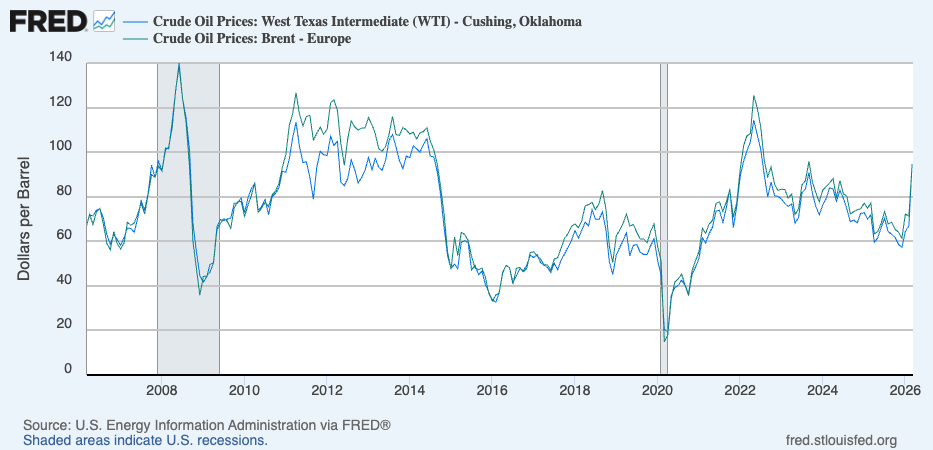
It’s not rocket science to conclude that higher crude prices are bad news for consumers as they mean higher prices for refined oil products, including gasoline, diesel, jet fuel, and heating oil. As of Friday, the national average price of regular unleaded gasoline was $3.63 a gallon, up from $2.94 a month ago, according to data from AAA.
And this isn’t just about higher prices at the pump. Oil is used to make plastic, rubber, fertilizer, synthetic fiber, and many other goods. Businesses use a lot of energy to manufacture and transport products of all kinds across the country and the world, which means the prices of those goods may rise to offset rising costs.
It doesn’t help that these higher costs are coming as many economic metrics have cooled significantly since the last time we saw crude prices this high.
“Underlying income and consumption have been slowing to begin with; we’re layering an energy shock on top of this,” Renaissance Macro’s Neil Dutta wrote on Friday.
The big question right now is how long oil prices will remain elevated. Even if they do return to the lower levels seen earlier this year, do Middle East tensions threaten future price spikes? Heightened uncertainty about energy prices, even when lower, makes it challenging for businesses to plan ahead.
I don’t know the answers to these timeline-related questions. Experts have presented a wide range of scenarios. While the stock market has tended to look past geopolitical events, the trajectory of wars isn’t uniform or predictable.
I do know that our relationship with energy has changed over the years.
In fact, President Trump reminded us of this when he recently said, “[W]hen oil prices go up, we make a lot of money.”
So, while many of us hate rising oil prices, some love them.
Below are eight charts that help us better understand how oil prices affect the economy and the businesses underlying the stock market.
