

What’s the right way for a company to report earnings?
Every publicly traded company is required to report quarterly financial performance in accordance with generally accepted accounting principles (GAAP), which is set by the Financial Accounting Standards Board.
But the rigid standard forces companies to incorporate items that are arguably non-recurring (e.g., restructuring costs, legal settlements, and gains or losses on asset sales) or have values that can be volatile over short periods (e.g., unrealized gains and losses on investments).
This has led many companies to report a second set of numbers adjusted for items that management argues don’t reflect the underlying, ongoing performance of the business. This process gets you to what are often referred to as operating earnings, adjusted earnings, pro-forma earnings, or non-GAAP earnings.
But the decision to report adjusted earnings is at the discretion of management, which means analysts and investors often have to make their own judgments about what should and shouldn’t be considered when analyzing financial performance.
It’s all very complicated, and it’s usually something you don’t have to worry about.
But Q1 had some high-profile companies reporting big swings in earnings driven by items that arguably should be adjusted.
Trillion-dollar companies reported multibillion-dollar investment gains and losses 💸
In addition to selling goods and services, some companies carry large portfolios of investments, including shares of public and private companies.
Berkshire Hathaway famously has a massive stock portfolio, which has helped drive the company’s long-term returns. However, Berkshire’s executives aren’t fans of how they have to account for those holdings. It’s why the company’s brief two-page earnings announcement released Saturday had one paragraph that was in both bold and italic font:
The amount of investment gains (losses) in any given quarter is usually meaningless and delivers figures for net earnings per share that can be extremely misleading to investors who have little or no knowledge of accounting rules.
The now-retired Warren Buffett and departed Charlie Munger had long decried this line item in their income statement. (More here, here, and here.)
Unfortunately, they have to report it. As explained in the release: “Generally Accepted Accounting Principles (‘GAAP’) require that we include the changes in unrealized gains (losses) of our equity security investments as a component of investment gains (losses) in our earnings statements.”
In short, they’ve argued: 1) Equity prices can be volatile over short periods, especially over three-month periods covered in quarterly earnings reports. As such, it adds the appearance of volatility to quarterly financial performance. And 2) These are unrealized losses, which means they reflect changes in value for securities that weren’t sold (which they might not intend to sell for years).
Berkshire reported Q1 operating earnings of $11.3 billion. But because of the stock market pullback during the period, the company had to report $1.2 billion in unrealized investment losses, which pared net earnings to $10.1 billion.
Meanwhile, a few megacap tech companies experienced the opposite during the period, reporting huge gains on private investments.
From Amazon.com: “First quarter 2026 net income includes pre-tax gains of $16.8 billion included in non-operating income from our investments in Anthropic.“
From Alphabet, which has big stakes in Anthropic and SpaceX: “Other income reflected a net gain of $37.7 billion, primarily the result of net unrealized gains on our nonmarketable equity securities.“
It’s great that we have this transparency, so the more sophisticated investors can separate these figures as we analyze the performance of these companies’ core businesses.
But it appears that these 11-figure unrealized windfalls were included in the numbers measured against analysts’ forecasts. As Deutsche Bank’s Binky Chadha wrote on Monday, “Indeed, popular reporting platforms like Bloomberg, which have not made these adjustments, are showing significantly stronger beats and growth numbers.”
And so we got stories about how Amazon.com and Alphabet reported earnings “nearing double Wall Street’s” estimates.
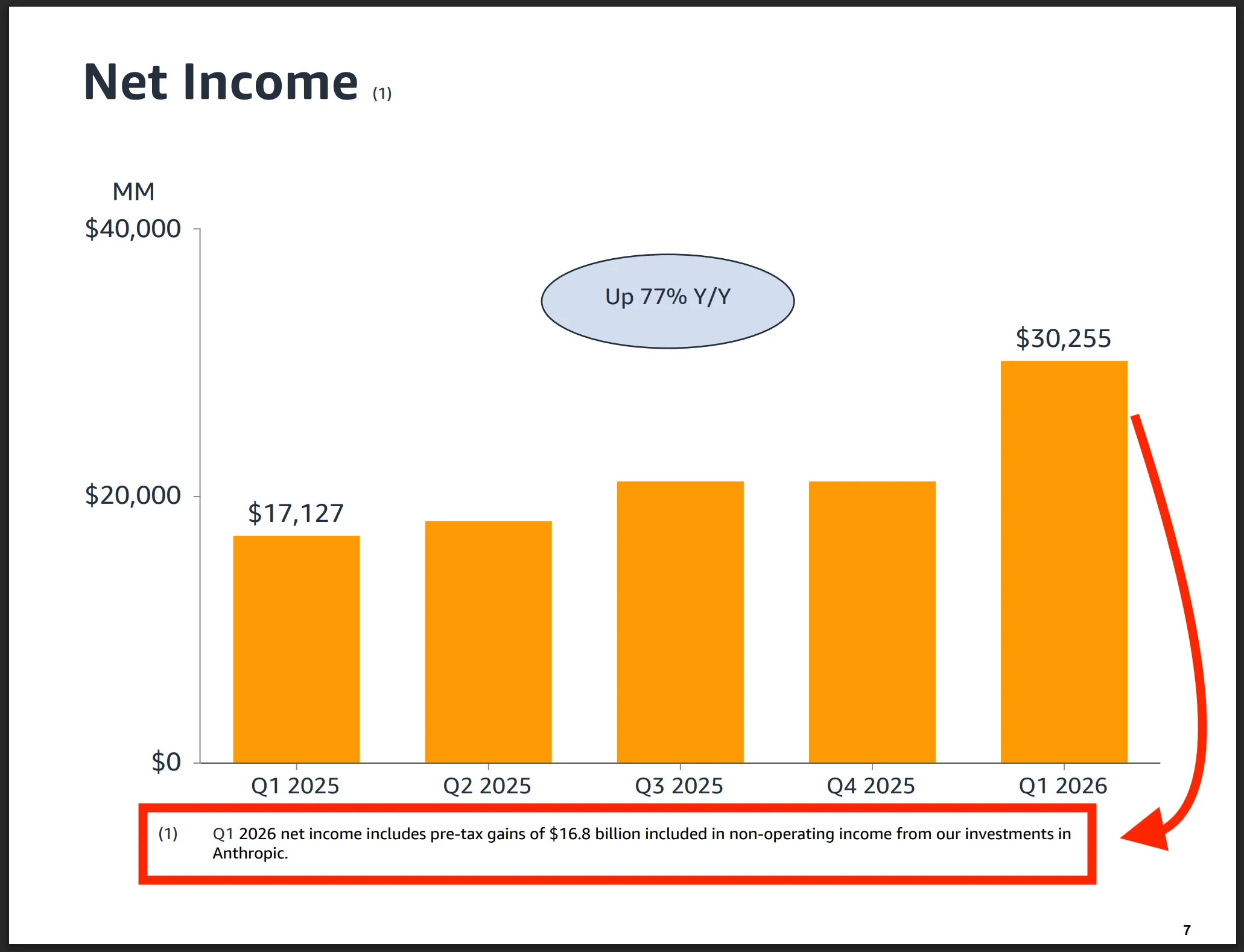
FactSet’s John Butters found this peculiar. From his note on Monday (emphasis added):
It is important to note that EPS reported on a GAAP basis by Alphabet, Amazon.com, and Meta Platforms was used for both the earnings surprise and the earnings growth rate calculations, as the majority of analysts contributing EPS estimates to FactSet for these three companies are providing EPS estimates on a GAAP basis. Alphabet, Amazon.com, and Meta Platforms historically have only reported EPS numbers on a GAAP basis.
It is interesting to note that all three companies highlighted items in their Q1 earnings releases that had a positive impact on GAAP earnings for the quarter. The (GAAP) EPS actual for Alphabet for Q1 2026 included a net gain of $37.7 billion primarily due to net unrealized gains on non-marketable equity securities. The (GAAP) EPS actual for Amazon.com for Q1 2026 included pre-tax gains of $16.8 billion included in non-operating income from investments in Anthropic. The (GAAP) EPS actual for Meta Platforms for Q1 2026 included an $8.03 billion income tax benefit. Meta Platforms also stated that EPS excluding the tax benefit for the first quarter would have been $3.13 lower.
To be fair, it’s not new for these megacap companies to hold investments with fluctuating values. But the scale of the gains in Q1 was unusual.
Goldman Sachs’ Ben Snider examined the history of the income statement line item capturing this phenomenon. From his note (emphasis added):
