

One of the big stories in the stock market today remains how the largest companies account for an outsized share of the market’s total capitalization.
Skeptics warn that this presents a risk to the market. But as we’ve discussed on multiple occasions, history shows that even if the dominant names lag, the broader market can continue to rally. Read more here, here, here, and here.
Tim Edwards, head of index investment strategy at S&P Dow Jones Indices, looked back at what happened after 1965, when the 10 largest stocks of the S&P 500 accounted for nearly 40% of the index. As you might have already guessed, those names didn’t fare well.
“The aggregate performance of the June 1965 top 10 cohort was underwhelming,” Edwards wrote. “Three entered bankruptcy proceedings, all fell to represent much smaller weights, and several represent potential business school case studies in ‘what went wrong’ with once widely admired and dominant U.S. corporations.“
This period included some spinoffs and demergers, complicating how you measure the price performance. (More details here.) But the bottom line is that the group fell behind.
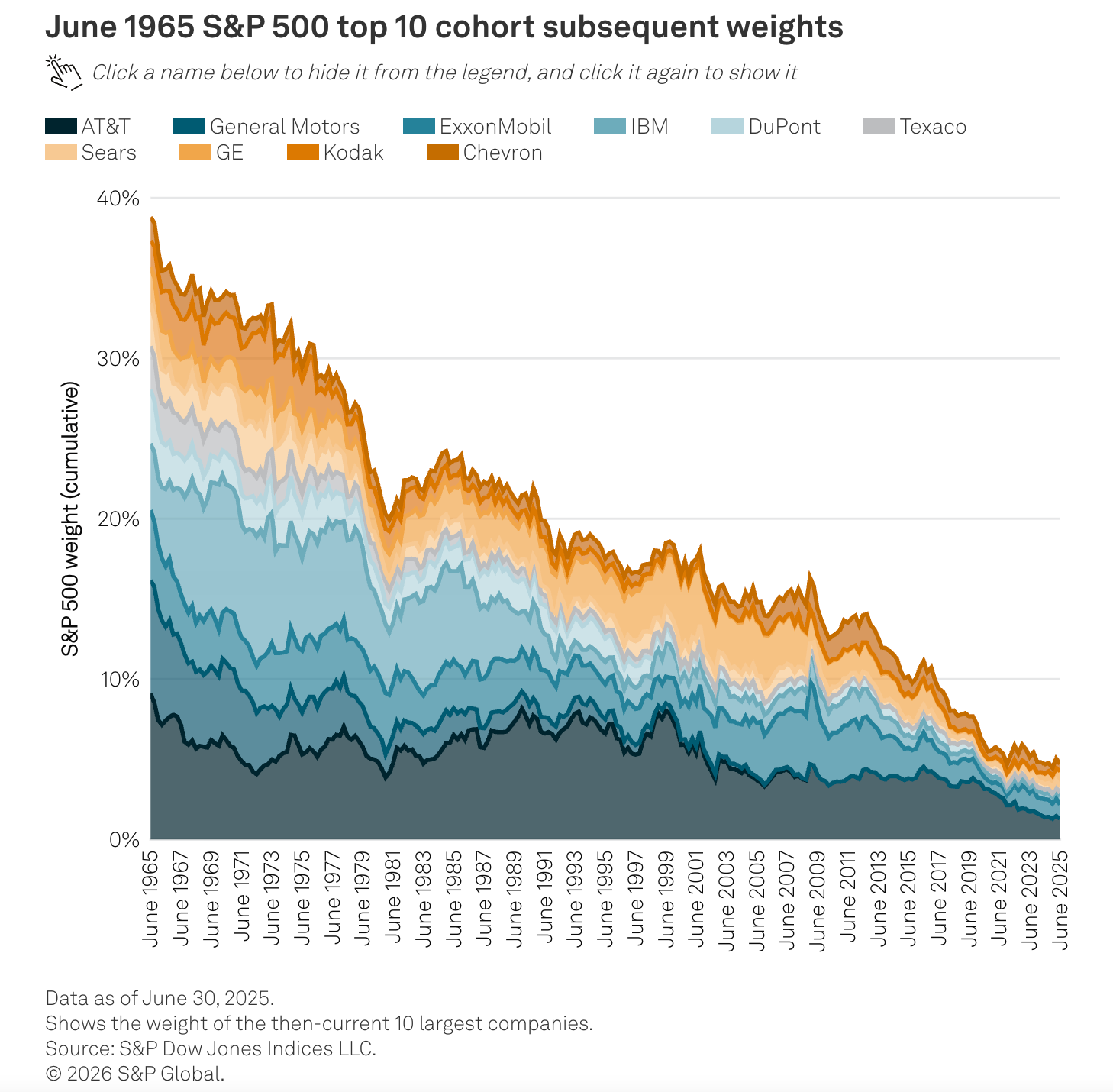
But broadly diversified investors tracking the S&P 500 did much better than those 10 names.
