

Much of what we know about the stock market comes from a mix of theory and empirical evidence.
For example, the idea that earnings drive stock prices is supported by the view that a business’s value is tied to how much money it makes. And decades of market data show that stock prices and earnings have exhibited a tight correlation.
There are also ideas that make intuitive sense, but the evidence supporting them is shoddy. In the stock market, this is a big problem because people will trade on these ideas, only to underperform the market.
Especially when it comes to price behavior, if a theory were both sound and reliable, we’d probably hear more about people consistently beating the market with some bulletproof trading strategy. But we don’t.
With that in mind, here are five ideas about the stock market that I’d describe as myths or misunderstandings.
1. Stock market returns revert to a mean 😵💫
Periods of strong stock market returns should be followed by periods of weak returns, and vice versa. Right?
If you take a long-term chart of the stock market and add a trendline, you’ll see prices above the line for some time and below it most of the time. This makes it tempting to say that the market exhibits mean reversion, or a tendency to gravitate back toward some historical average.
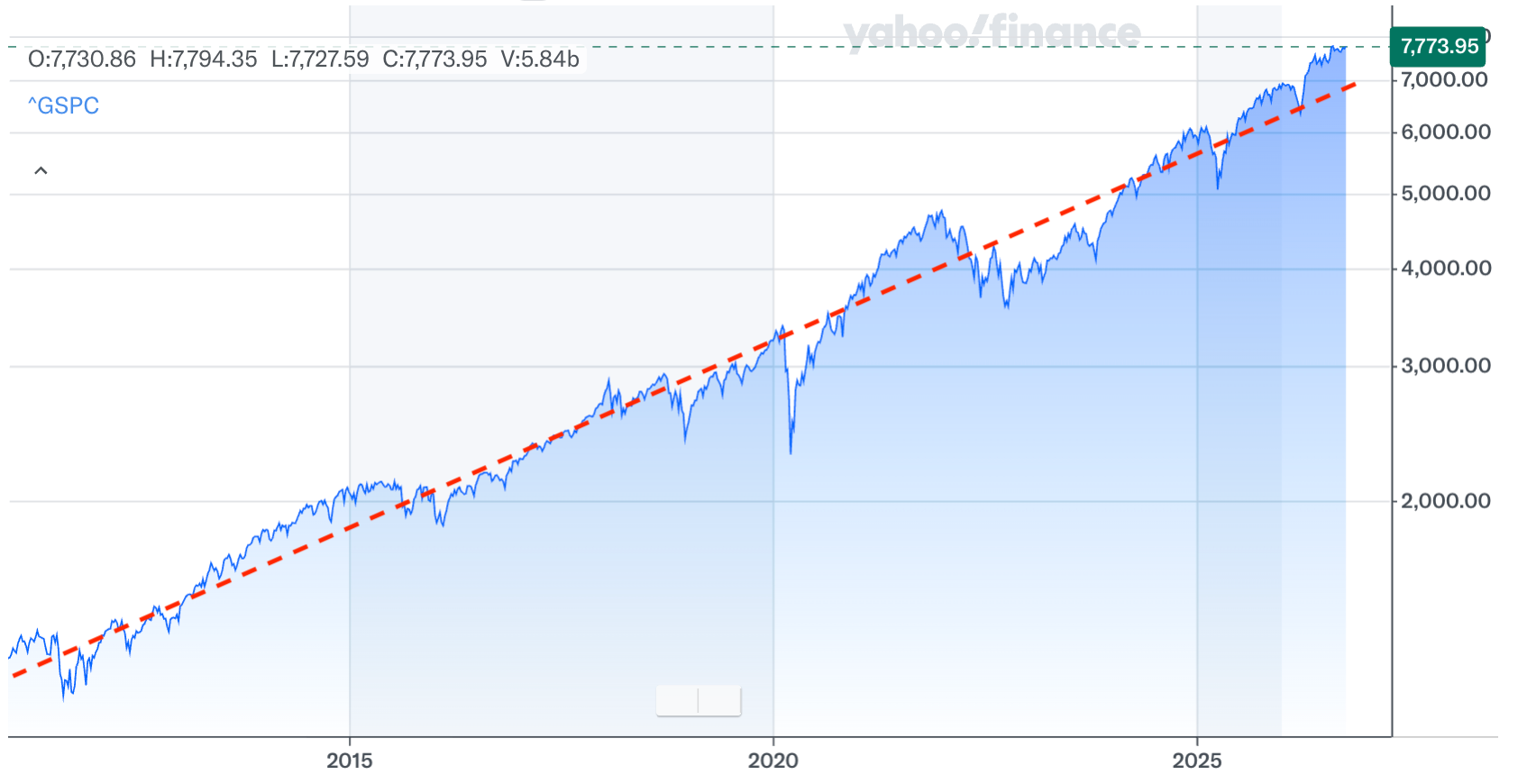
Unfortunately, this behavior is so inconsistent that Professors Paul Marsh, Mike Staunton, and Elroy Dimson concluded that “popular evidence for mean reversion is an ‘optical illusion’ that employs hindsight.” They addressed this issue in the 2025 edition of UBS’s “Global Investment Returns Yearbook” and also explored it at length in the 2013 edition, when Credit Suisse published it.
They even went so far as to compare the belief in mean reversion to the Gambler’s Fallacy, the assumption that past outcomes inform future ones.
If mean reversion in the market were consistent and predictable, then there would be a way to trade the phenomenon in such a way as to generate above-average returns. But you don’t really hear about funds or traders consistently beating the market by trading the expectation of mean reversion. (Maybe some secretive hedge fund somewhere has figured it out and they’re not telling us.)
“Market-timing strategies based on mean reversion typically gave lower, not higher, returns,” Marsh, Staunton, and Dimson found.
That’s not too surprising when you see the various stats showing periods of strong returns are often followed by more strong returns. Indeed, history shows that investing at all-time highs has produced better returns than investing on all other days.
Keep this in mind the next time someone suggests we’re “due” for weak returns because we just experienced strong returns. What just happened won’t tell you what’s coming next.
Read more about this here.
2. Valuations revert to a mean 😵💫
One of the most popular ways to measure value is to divide an asset’s price by its earnings. This is the price-to-earnings (P/E) ratio. When a stock’s P/E is above its historical average, it’s considered expensive. When it’s below average, it’s considered cheap.
This has led many to assume that expensive stocks tend to get cheaper and cheap stocks tend to get more expensive. In other words, valuations tend to revert to a mean, right?
“We cannot emphasize enough that valuation metrics are NOT historically mean-reverting,” Goldman Sachs analysts wrote in January. They’ve characterized it as “an oft-repeated myth.”