

📉 The stock market fell, with the S&P 500 shedding 1% last week to close at 5,954.50. It’s now up 1.2% year to date and up 66.5% from its October 12, 2022 closing low of 3,577.03. For more on market moves, read: Investing in the stock market is an unpleasant process 📉
-
When the stock market falls more than 1% in a day or a couple percentage points over a couple of days, I always get the feeling that it’s the beginning of a much bigger sell-off.
This has been consistent in my 19 years of writing about stocks. To be fair, it’s a rational feeling to have because stock market history is riddled with big, lengthy sell-offs. And you can be sure there’ll be big sell-offs, including bear markets, in the years to come.
That said, something that has changed over the years is my growing familiarity with the data, which has made me a better investor less prone to making emotionally-driven adjustments to my portfolio.
Just last week, I learned something fascinating from a Bespoke Investment Group blog post:
Emotions and investing don’t mix. Emotional investors tend to sell when the market is going down and buy when the market is going up. They should be doing the opposite. As shown below, if you only owned the U.S. stock market on the day after up days since SPY began trading in 1993, your cumulative gain would be just 44%. If you only owned the market on the day after down days, you’d be up 851%!
The chart is stupefying.
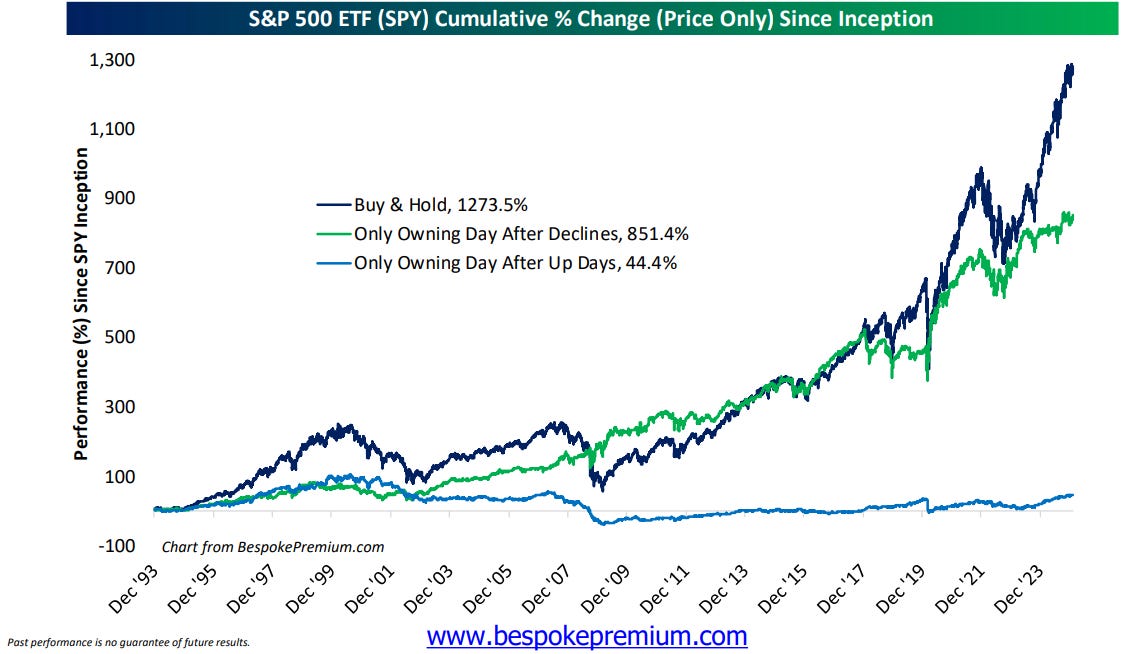
Sure, buy-and-hold clearly dominates. And owning only on the days after up days still came with a positive return.
But owning only on the days after declines — which are the days many investors usually feel less bullish — have produced returns that eclipse owning only on days after up days.
