

📆 TKer will be off next Sunday, Nov. 29. The free weekly newsletter will return on Sunday, Dec. 6.
-
From Dec. 2, 2015 to Feb. 11, 2016, the S&P 500 fell 14%. Do you remember what that was about?
I remember my stock portfolio got slammed. But I honestly struggle to recall what drove the market drawdown. However, there are clues in a piece I wrote on Feb. 5, 2016. Here’s an excerpt:
Every major sell-off in history has been accompanied by a mix of economic concerns, monetary policy shifts, geopolitical tensions, or some other source of consternation that might make a rational person demand a higher premium for putting their capital at risk. The details are different each time. But structurally, it’s generally the same story: it’s risky out there.
I’ve resurfaced this passage several times before here, here, and here.
My point isn’t, and never was, to downplay the concerns of the moment. Rather, it’s to remind folks that there are always risks out there (Truth No. 7) and that big sell-offs happen (Truth No. 2).
In fact, big sell-offs are so frequent that it’s easy to forget what past ones were about if you don’t write it down.
We’ll talk a little more about what we do and don’t remember in a little bit.
The stock market is tumbling 📉
The S&P just had its worst week since April 2025, falling 8.6%. The index just had its seventh consecutive down day, the first such streak since February 2020. It’s now down 11.6% from its Oct. 6 high.
We’ll see if this drawdown gets worse and by how much.
For now, there’s no shortage of stories to blame. For starters, we’ve had elevated interest rates and high energy prices for months. Inflation has remained stubbornly above the Fed’s target, making the outlook for monetary policy increasingly hawkish. Meanwhile, geopolitical tensions remain elevated.
For most of the year, none of this seemed to rattle stocks. Probably because none of it appeared to affect the outlook for corporate earnings, which has only improved, and earnings are the most important driver of stock prices. This has all been supported by continued job gains and persistent consumer spending.
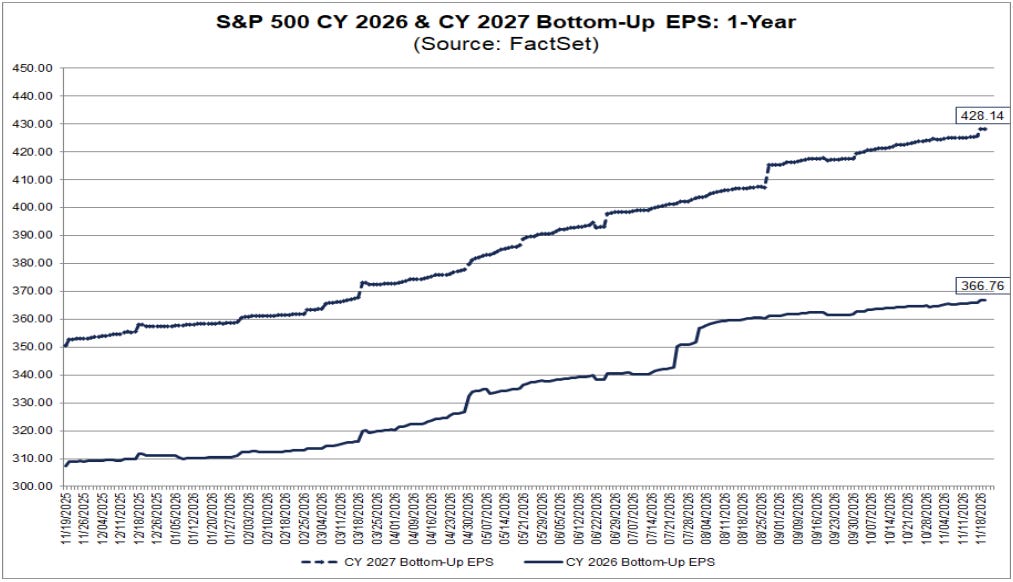
Yes, there are some known headwinds related to AI, but at least some concerns have been reflected in falling valuations.
But the past few weeks have been riddled with stories that increasingly shook market confidence.
A slew of high-stakes events 😬
This month kicked off with the midterm elections on Nov. 3, which came with Democrats winning control of both chambers of Congress. As election results came in, markets fell that Tuesday night and surged Wednesday morning.
But then markets plummeted Thursday, Nov. 5, with the S&P 500 dropping 4.4% in the worst single-day sell-off since April 2025.
Meanwhile, a scandal was coming to a head at Nvidia, the multi-trillion tech company driving the AI revolution. On Oct. 29, the New York Times reported that CEO Jensen Huang was entangled with a suspected Chinese spy, who may have helped divert Nvidia chips to China in violation of U.S. export controls. On Nov. 8, Huang admitted to having an affair with her. Within days, news broke that Huang had affairs with at least two company subordinates. On Nov. 12, he resigned as CEO and board member of Nvidia.
Also on Nov. 12, Microsoft experienced outages that affected widely used services, including Outlook, Teams, and Copilot. It took two days before Microsoft “completed our efforts to address the underlying issue.”
On Nov. 13, the FAA issued a nationwide ground stop. Air traffic resumed after about five hours. The last nationwide ground stop was in January 2023, and 9/11 before that.
On Nov. 16, customers of major U.S. banks, including JPMorgan Chase, Bank of America, and Wells Fargo, reported having trouble accessing their accounts. That day, United Airlines experienced a widespread outage affecting departing flights.
Then came Nov. 17, when paranoia seemed to gain even more traction. CNN reported that a classified internal communications network used by the NSA went down. Apple faced outages affecting various services. All on a day when FEMA scheduled a nationwide test of its Emergency Alert System.
Meanwhile, rumors of a 90-day blackout went viral on social media, fueling conspiracy theories that everything we’ve experienced this month was related and that the worst was yet to come. I’m not going to get into all that. But here are some headlines from Nov. 17:
Emergency alert test sparks rumors of a blackout. What’s going on? - USA Today
Costco Shoppers Are Panic-Buying Due to Outages, Analysts Say - Bloomberg
Rubio says US not ‘under systemic attack’ after series of tech outages - BBC
JD Vance insists no need to panic-buy emergency supplies — but still ‘be prepared for everything’ - NY Post, Nov. 17
Essentially, every major outage has been resolved. Most have been attributed to hiccups related to software and hardware updates. As far as we know, nothing catastrophic is unfolding.
That said, none of this stuff is great for confidence.
We also shouldn’t overlook that on Nov. 19, AI developer Anthropic began trading on public markets at a $2 trillion valuation. The company’s IPO consisted of 980 million shares priced at $83 per share. The $81.34 billion IPO is the largest in history.
On Thursday, Anthropic got as high as $115.10 per share, a 39% pop. But on Friday, it closed at $88.91, down 22.8% from the high.
Maybe Anthropic goes down as one indicator of AI’s peak. We’ll see.
In other news, Grand Theft Auto VI, perhaps the most anticipated video game in history, was officially released on Nov. 19 to rave reviews. Rumored to be the most expensive game ever produced, GTA VI generated about $3.8 billion in sales in 24 hours. According to PCMag, “8% of US adult gamers plan to take PTO or adjust their work or school schedules to play. When we do the math, that translates to an estimated 12.5 million U.S. gamers.”
It seems silly. But that’s not a trivial number of people who’ll be consumed by a video game. We’ll see if it shows up in upcoming economic data or earnings announcements.
Will we remember all this? 📜
I’ve been in the news business for a long time, and I can tell you it’s hard to judge whether it’s a big news day when you’re living it in real time. This seems especially true in financial news.
In real time, when the market makes big moves, people are quick to back into stories that may explain what’s happening.
However, big moves are relatively common, and so people often forget these periods and the stories. Do you remember what happened the last five times the S&P 500 fell more than 3% in a single day? Can you recall what developments were associated with the last couple of 10% extended drawdowns?
Creative Planning’s Charlie Bilello reviewed the 34 times since March 2009 that the S&P fell by more than 5% from its high. Do you remember all these?
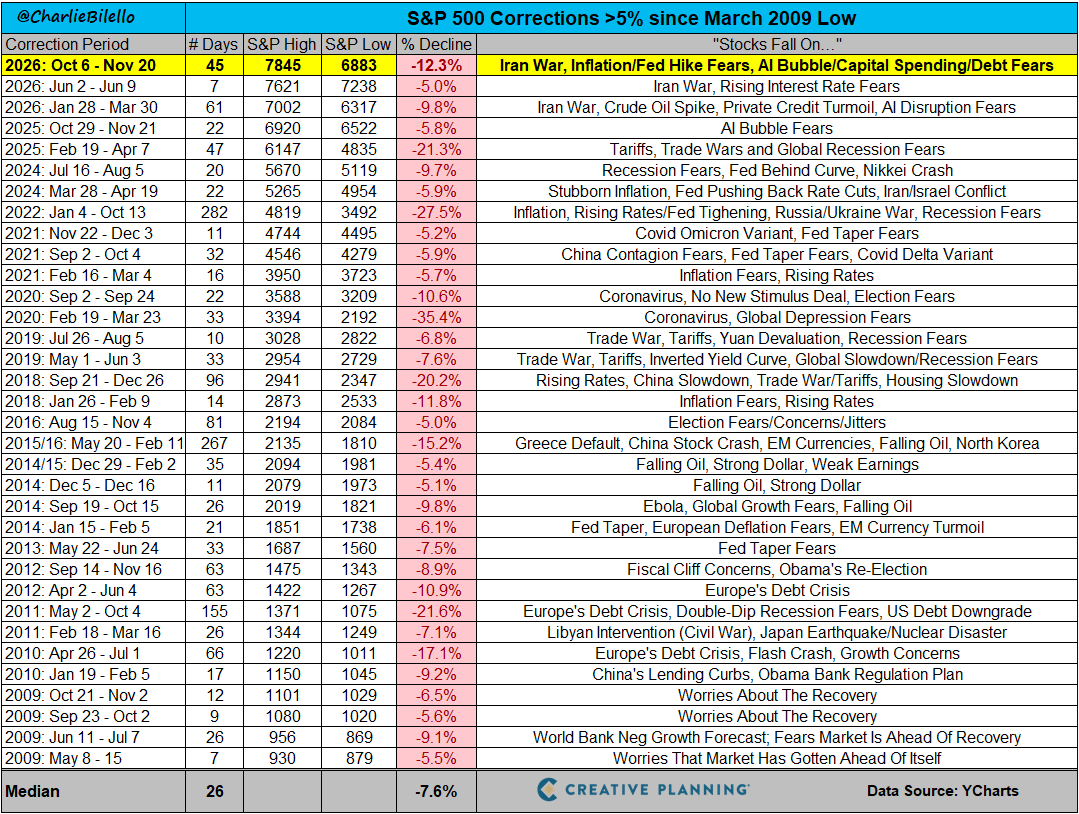
Maybe you remember some of those periods, but not all of them. Because more often than not, those market losses are limited and temporary, and many of the related stories prove immaterial in the context of a long-term investor’s time horizon.
Now I know some people are fine with forgetting worrisome moments.
But as a long-term investor, I think it’s helpful to remember and reflect on unsettling periods, even when they prove to have little impact on your long-term returns. Because it can help you put future bad news into context.
The more you recognize that the feelings you’re having aren’t new, the less vulnerable you are to making an investing mistake. This is why I often recommend journaling when you worry things could get worse.
Maybe things do get worse. Maybe they don’t. Either way, having a record of what happened and how you felt can help you navigate the endlessly treacherous investing environment.
Write it down now, look back on it later 📓
Honestly, everything that’s happened and everything going on right now makes me a bit nervous. Then again, investing always makes me feel uneasy.
Keep in mind that the S&P 500 has historically experienced an intra-year max drawdown of 14%. That means the S&P would have to fall another two or three percentage points for it to be an average year.
That said, I know two things.
First, if the markets remain calm and the trend higher resumes, most of us will quickly forget many of these recent events and the feelings we felt.
Second, if we do get a steeper downturn — like a drawdown greater than 14% — I think it’ll still be the case that most of us will forget many of the details of recent events. While I can recite the market stats from the dotcom bubble, the global financial crisis, and the COVID-19 pandemic, I’m still taken aback when I dig deeper and recall the feelings of fear and hopelessness from those periods.
So I encourage you to write down what concerns you, how you feel, and where you think things are headed.
Down the road, we’ll look back at this as an important moment, or a period we forget. Either way, there’ll be lessons learned upon reflection.
-
Related from TKer:
When I thought things took a permanent turn for the worse 🙇♂️
Burying your head works for some, but it’s not the best advice 🫣
Review of the macro crosscurrents 🔀
📉The stock market fell last week, with the S&P 500 tumbling 8.6% to end at 6,910.39. The index is now down 11.6% from its October 6 closing high of 7,818.93 and up 0.9% year to date. For market insights, check out the Stock Market tab at TKer. »
There were several notable data points and macroeconomic developments since our last review: