History tells us the stock market usually goes up regardless of which party occupies the White House. It also shows that the market usually quickly looks past geopolitical shocks like the start of a war. Similarly, the market has always adjusted to economic turmoil sparked by the emergence of paradigm-shifting technologies.
As a result, it’s somewhat popular to say that people should ignore jarring headlines in the context of their investment portfolios.
On that matter, here’s what Joe Weisenthal asked me on Bloomberg’s Odd Lots podcast during a panel discussion about the AI’s threat to the economy as we know it:
Per the theme of your Substack — generally speaking, stocks go up — is the sub-theme to just ignore everyone else on the stage? Because you’re just going to get distracted, and you’re going to get freaked out, and whatever. …Ignore all the Odd Lots episodes, ignore all the news, ignore the doomers. Because in the end, the only thing that can happen if you pay attention to the news is you do something stupid. Then you missed the long run.
Check this episode of Odd Lots on Spotify, Apple Podcasts, or Bloomberg!
His question cuts to advice that some investors have found helpful. The “bury your head in the sand” playbook can be the right one for those without the intestinal fortitude to hold on to their investments when sh*t hits the fan. Forget your retirement account passwords and ignore the news, and in a couple of years, you’ll hopefully have made progress toward your financial goals.
But for most people, I think this approach is a mistake. Here’s how I answered Joe’s question (edited for clarity, emphasis added):
I’m actually the complete opposite of that. Like I said before, I’m always worried. And this is sort of the message I try to communicate out to the world. I do a lot of things that are kind of counterintuitive. Like, I do check my 401(k) plan every single day. A lot of advisors and professionals will go on TV and say to forget your 401(k) password, or ignore politics, or ignore what’s going on in Iran. We have a long history of getting past all this stuff.
I think that’s all incredibly silly. I think you really do have to think about how bad things are at a given time. That way, you build up those memories so that, 10 years from now, when there is another war, you will remember how bad things were in the past. And you’ll know how markets evolved out of all that stuff.
To ignore things makes you more vulnerable to making mistakes. So yeah, be really conscious where there are [AI-related] job losses, and where there will be industries that fall apart. Because all the lessons you learn today from all the bad things that happen — when you lose your job, and when your neighbors lose their job — and then a couple years from now, maybe the market’s higher. You know, 10 years from now, it’s going to happen all over again, and you’re more robust when that stuff happens. So, I think it’s a complete mistake to ignore terrible things that are going on — as someone who’s optimistic in the long run.
Ignoring or forgetting unpleasant events might come with mental health benefits in the short run.
But in the long run, I think it does more harm than good. Because it could mean putting off a valuable lesson, which could have better prepared you for a similar event in the future.
Keep your thoughts organized 💭
Having a thorough bank of detailed memories, especially the bad ones, helps to better contextualize events causing anxiety today.
You may be thrown off if you don’t remember the last time the media fed you live shots of an escalating war, gave increased airtime to the doom mongers, or sent you frequent push alerts about 1,000-point drops in the Dow. Because when events are new to you, you’ll rightfully feel uncertain because in your mind, there’s no precedent for what comes next.
Consider this passage from the final post I wrote for Business Insider, back in February 2016, which I’ve repeated for TKer subscribers before:
Every major sell-off in history has been accompanied by a mix of economic concerns, monetary policy shifts, geopolitical tensions, or some other source of consternation that might make a rational person demand a higher premium for putting their capital at risk. The details are different each time. But structurally, it’s generally the same story: it’s risky out there. Amid all this, one pattern has stood the test of time: stocks will go down a lot, but then they’ll go up a lot more.
Sounds familiar, right?
Now, this may sound callous — and I’m speaking strictly from the perspective of investing — but the goal is to become a little less sensitive to bad news that you’ve seen before.
To be clear, this doesn’t mean not caring about serious issues. We are human, and bad news affects us and the people we love. In the context of politics and social issues, I think people should certainly be engaged and express their concerns and views. This is another reason why I think people shouldn’t ignore what’s going on in the world.
But in the context of investing, you wanna be like that wise grandparent who’s seen a lot and can match or one-up you every time you mention something difficult going on in your life. Not only are they often sanguine when others are panicking, but they’re also better equipped to identify those moments where things might actually be different this time.
The challenge is organizing your thoughts so you can be mindful of the world around you while thinking as objectively as possible about your finances, minimizing the risk of making emotionally driven mistakes.
For more on organizing your thoughts, read: 4 different ways of looking at the exact same economy 🪖👒🎩🧢
The past is often worse than you remember 🤔
For me, it’s not enough to be present in the moment.
I spend a lot of time looking back at past crises and market crashes. I have lots of old notes and printouts I thumb through. I’m always eager to read research and reflections from others. I sometimes write about it too (see here, here, and here).
For the events I lived through, I’m always struck by how much more intense and unnerving those events were than I can readily recall, which is why I keep thinking back on those moments.
To be clear, I also have lots of great memories from good times that I reflect on. But I believe it makes me more thoughtful to remember that the past wasn’t always perfect.
Because it feels like every couple of days, I read a news headline or get an alert on my phone that has me thinking: Are we on the cusp of a major market downturn?
To be fair, we always might be.
But usually, we aren’t.
Upon deeper reflection, we often learn that the day’s risk event rattling markets is often similar to the run-of-the-mill, short-term bouts of volatility we experience rather frequently.
All this is to say is that as unnerving as things are today, there were likely more unnerving periods in recent history.
Bruises, bike accidents, and broken bones 🤕
Growing up, I had my fair share of accidents.
I’ve received second-degree burns from fireworks. I once got the wind knocked out after jumping off a swing a little too high. I almost drowned while playing in a pool before I knew how to swim. In 7th grade at lunchtime, I choked on hamburger meat. Another time, I choked on a big ice cube. I tore up my knee after I flew over the handlebars while riding a road bike on a rocky trail. I’ve been knocked unconscious at judo practice, and I’ve had my wrist fractured at a judo tournament. I’ve even had my heart broken a couple of times.
These were unhappy experiences. But they were also valuable experiences. They’ve increased my threshold for emotional and physical pain. Importantly, they’ve made me more thoughtful about decisions I’ve made ever since.
I only wonder how I’d behave today if I didn’t have those experiences, or if I had forgotten about them or buried them away. I’d probably be at risk of much more danger than I am now.
To be clear, the memory of all these accidents won’t guarantee that I won’t make some choice in the future that leads to disaster. But at least I’ll be better informed and more thoughtful about my decisions.
Check this episode of Odd Lots on Spotify, Apple Podcasts, or Bloomberg!
-
Related from TKer:
Stocks usually look past geopolitics, but they shouldn’t be ignored 🫣
One of the most misunderstood moments in stock market cycles ⏱️
Remembering moments when I thought things took a permanent turn for the worse 🙇♂️
What I got wrong about the post-Global Financial Crisis recovery ❤️🩹
‘The thing I really want to emphasize is that nobody knows’ 🤷🏻♂️
It’s OK to have emotions — just don’t let them near your stock portfolio 📉
Review of the macro crosscurrents 🔀
📉The stock market declined last week, with the S&P 500 shedding 2% to end at 7,354.02. The index is now down 3.4% from its June 2 closing high of 7,609.78 and up 7.4% year-to-date. For market insights, check out the Stock Market tab at TKer. »
There were several notable data points and macroeconomic developments since our last review:
🚨 Apple products, XBox prices are going up because of AI. The booming demand for hardware to support AI infrastructure is affecting the consumer tech product supply chain. From Bloomberg (emphasis aded): “The starting price of the MacBook Neo is rising to $699 from $599, while the 13-inch MacBook Air is increasing to $1,299 from $1,099. The 14-inch MacBook Pro is moving to $1,999 from $1,699, while the 16-inch model is now priced from $2,999, up from $2,499… An Apple spokesperson said that ‘the rapid expansion of AI data centers has created an extraordinary surge in demand for memory and storage’ and that the company has “never seen a component price increase this much, this quickly.’ Apple added it has ‘shielded our customers from these increases so far, but we have now reached a point where we need to begin raising prices on a number of products, including today’s increases for iPad and Mac.’”
Similarly, from Microsoft: “The price of XBOX consoles will increase by US$100 for 512 GB models and US$150 for 1 TB models… Unfortunately, console storage and memory prices have increased by more than 2.5x and we expect another doubling by the fall of 2027. The entire consumer electronics industry is struggling with the current components crisis, but the effects are particularly hard on consoles.“
🎈 Fed’s preferred inflation measure jumped on higher energy prices. The personal consumption expenditures (PCE) price index in May was up 4.1% from a year ago, fueled by higher energy prices. The core PCE price index — the Federal Reserve’s preferred measure of inflation — was up 3.4% during the month, up from April’s 3.3% rate.
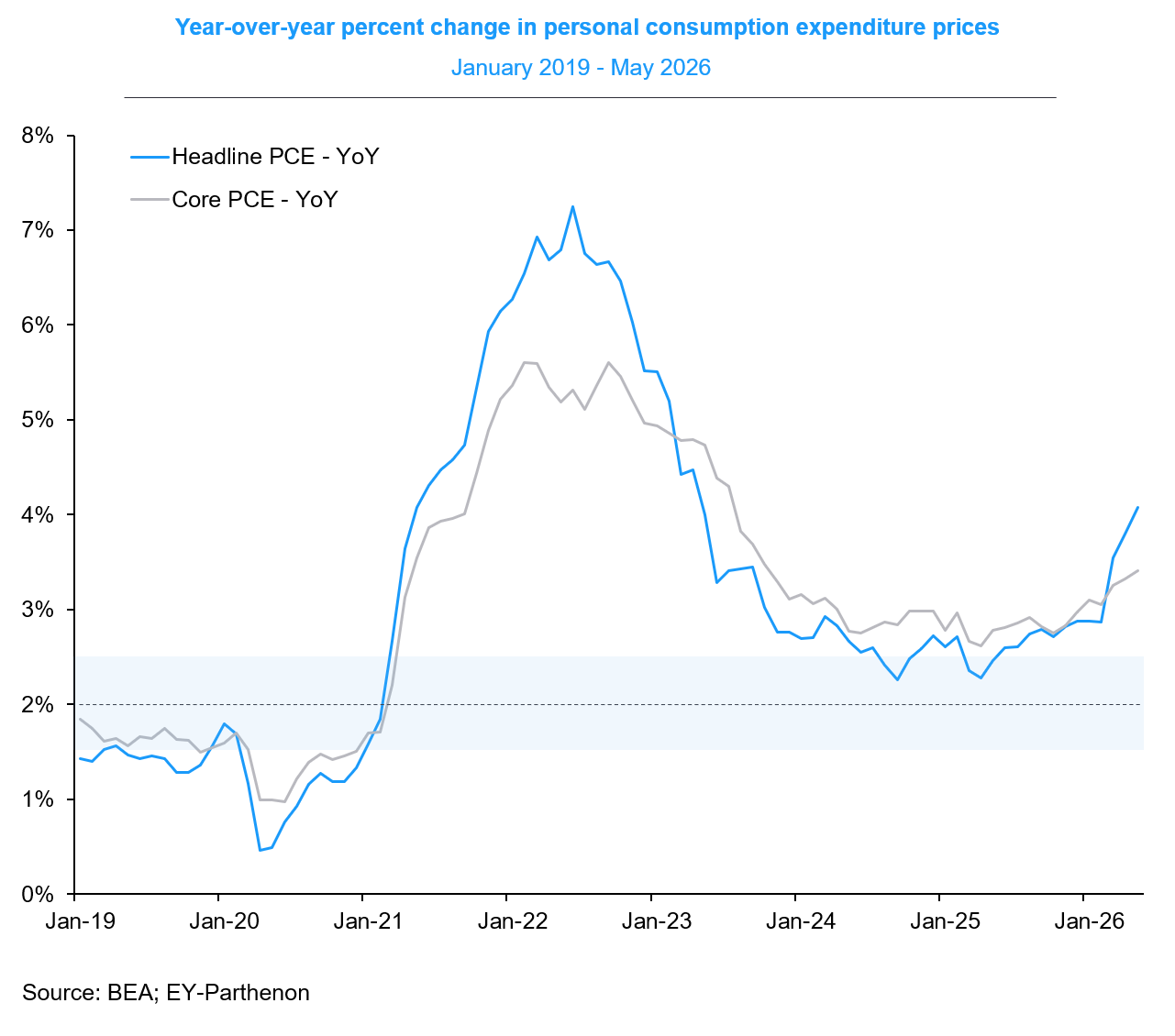
On a month-over-month basis, the core PCE price index was up 0.32%. If you annualize the three-month trend in the monthly figures — a reflection of the short-term trend in prices — core PCE climbed 4.1%.
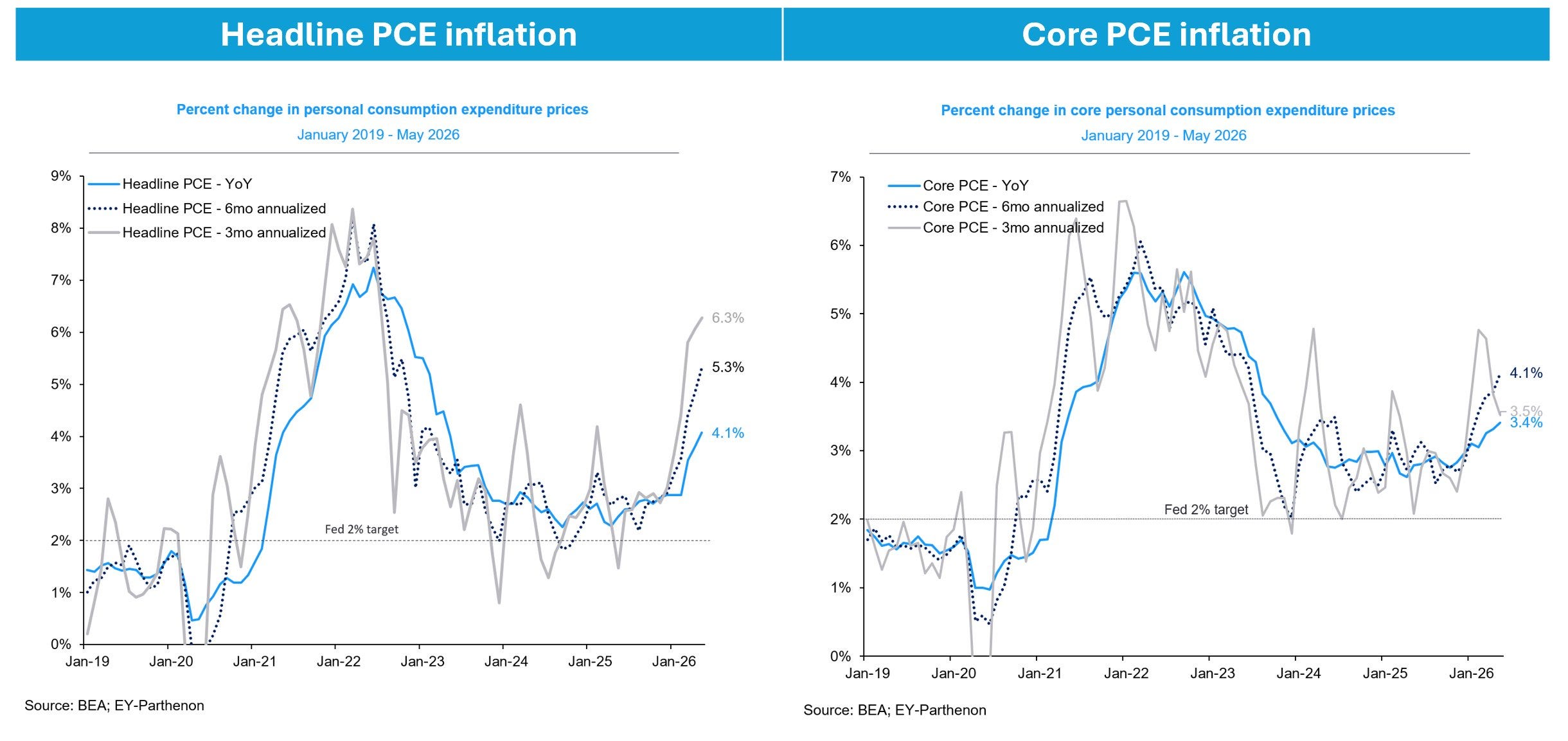
While inflation rates remain above the Federal Reserve’s 2% target, they are down considerably from peak levels just a few years ago. Nevertheless, the recent move higher bears watching.
For more on the Fed’s impact on markets, read: ‘When will the Fed cut rates?’ is not the right question for investors right now ✂️
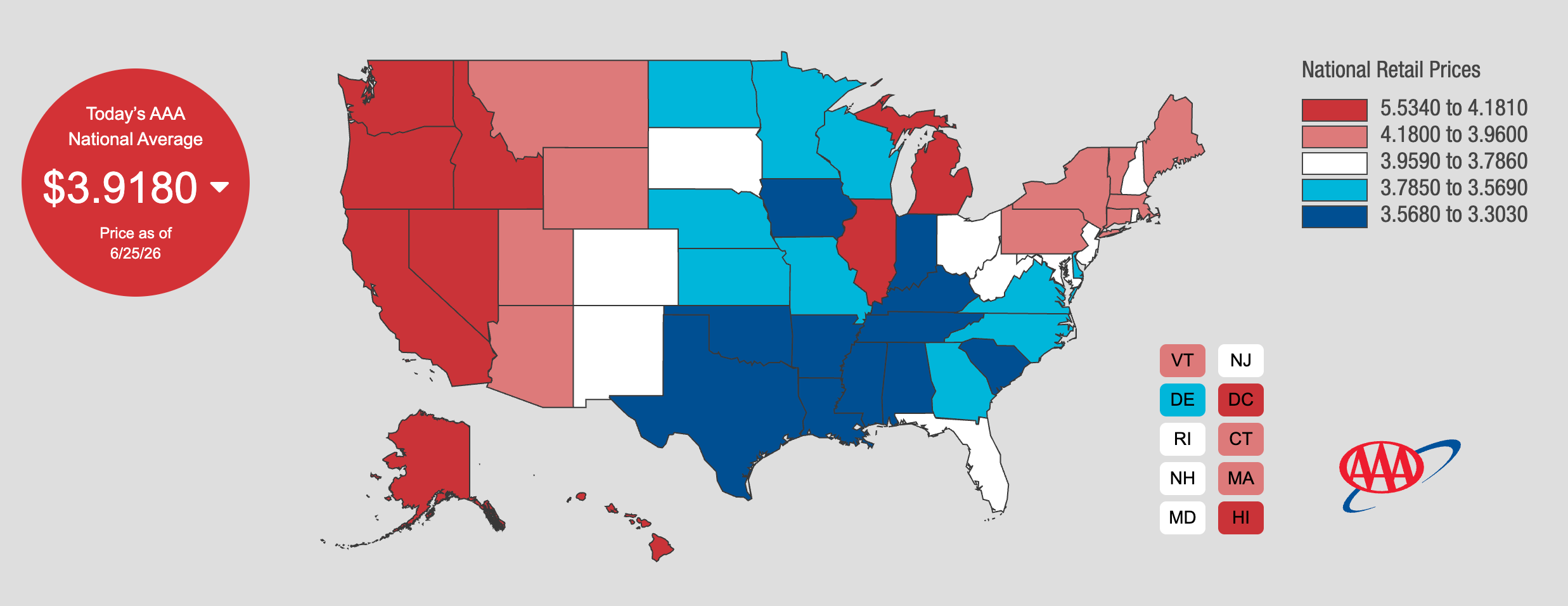
⛽️ Gas prices fall further below $4. According to AAA, the national average for a gallon of regular gasoline declined to $3.91, down from $3.99 last week.
Here’s a longer-term look at the trajectory of gas and diesel prices, as tracked by the EIA.
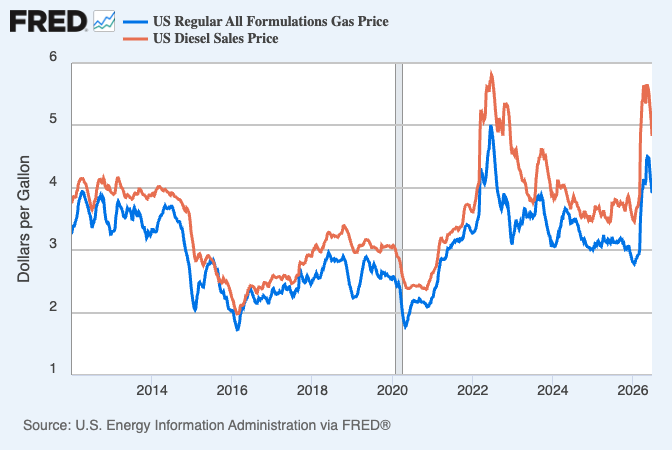
For more on energy prices, read: Our love-hate relationship with rising oil prices in charts 💔🛢️📊
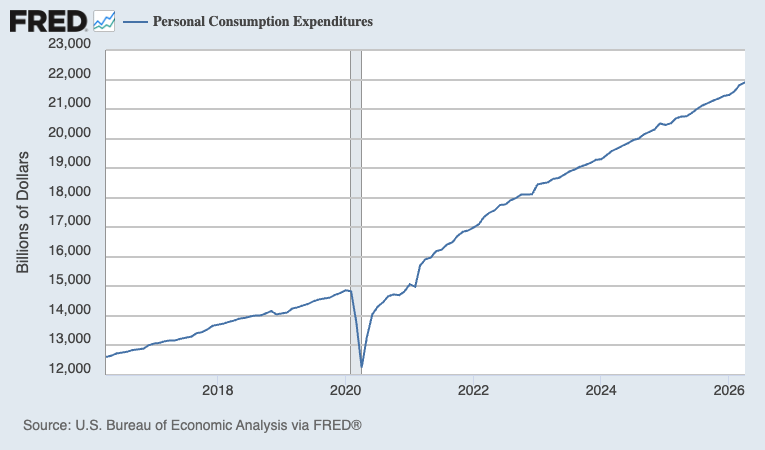
🛍️ Consumer spending ticks higher. According to BEA data, personal consumption expenditures increased 0.7% month-over-month in May to an annual rate of $21.90 trillion, an all-time high.
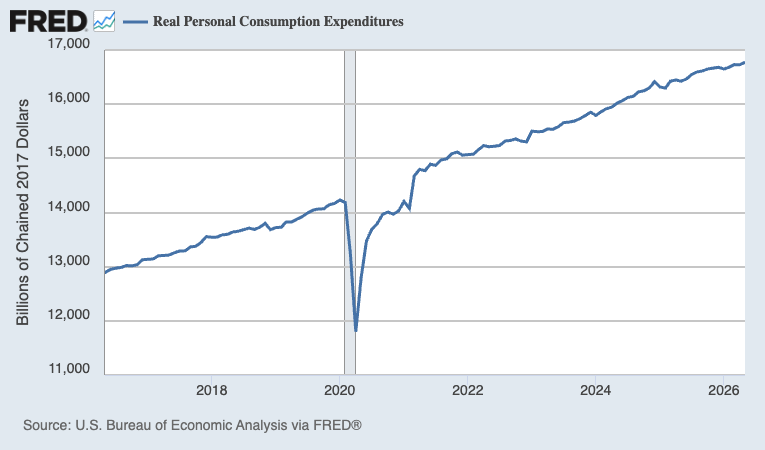
Adjusted for inflation, real personal consumption expenditures increased 0.3% from the prior month to another all-time high.
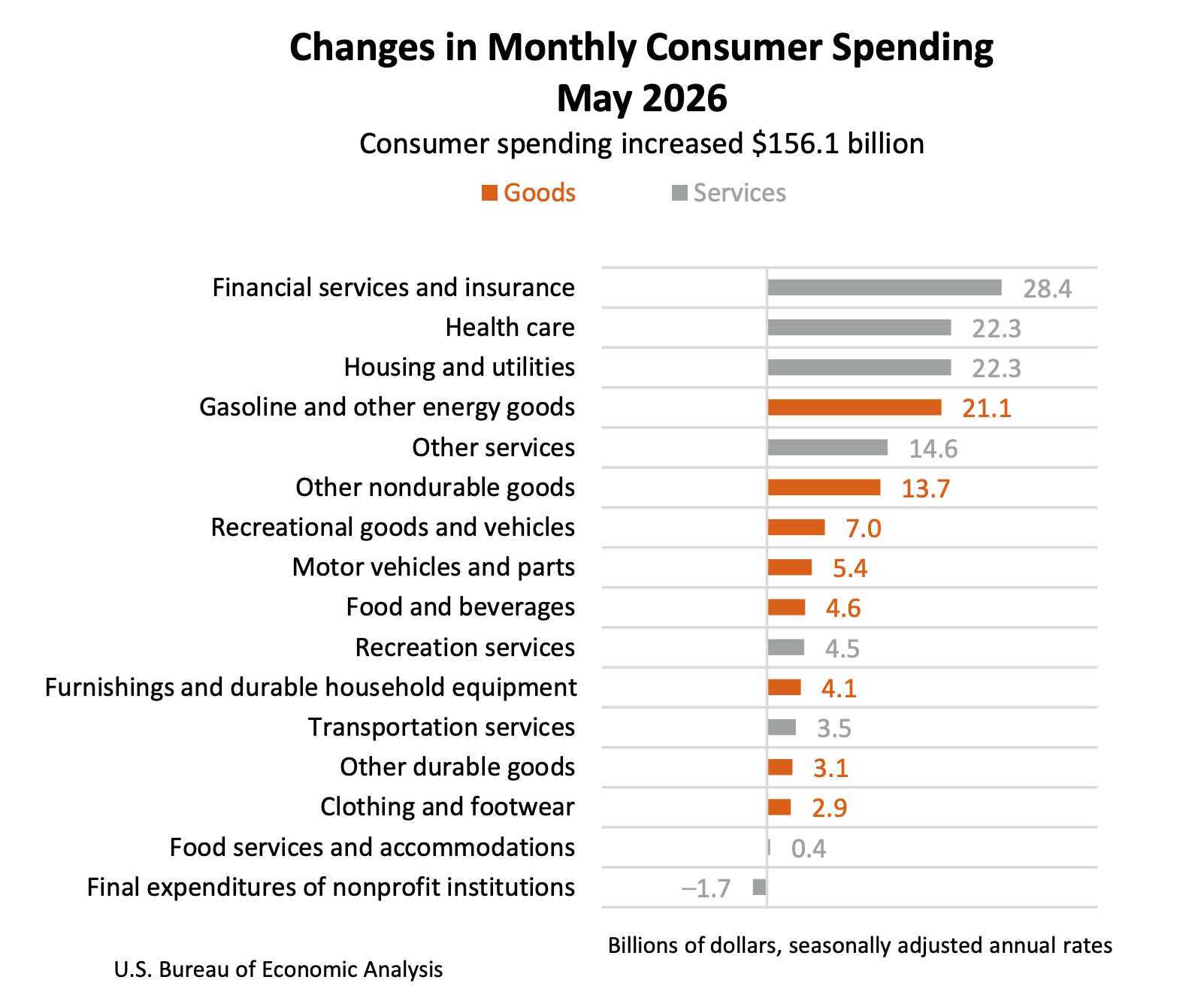
Here’s a breakdown of spending growth by category.
💰The personal saving rate is low, but that’s not obviously a bad sign. Personal saving — disposable personal income less personal consumption — has been shrinking over the past two years, causing the personal saving rate — personal saving as a percentage of disposable personal income — to trend lower. In May, the saving rate stood at 3.0%, the lowest level since June 2022.
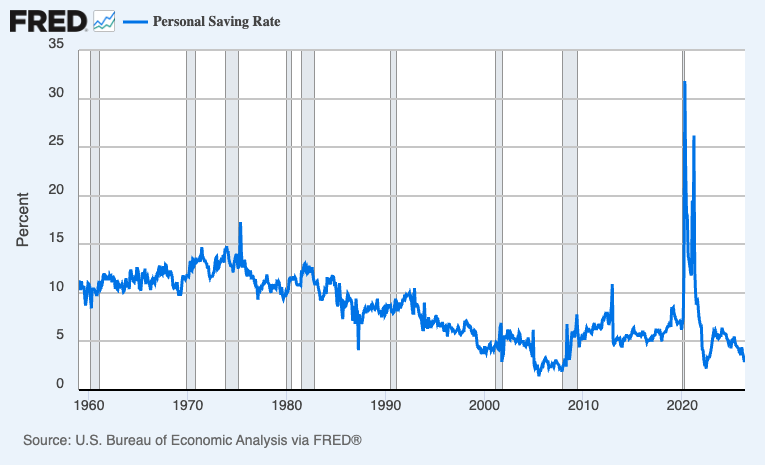
All else equal, this is not great. The implication is that more people are drawing from their savings to support their spending amid inflationary pressures. However, the saving rate tends to decline when net worths are rising. And net worths have been rising, driven by record-high home prices and elevated stock prices.
For more on this dynamic, read: A contrarian note about the falling personal saving rate 💸
💳 Card spending data is holding up. From BofA: “Total card spending per HH was up 6.8% y/y in the week ending Jun 20, according to BAC aggregated credit & debit card data. Ex-gas spending rose by a solid 6.1%. Gas spending growth came down since last week due to lower gas prices after the deal. Father’s Day timing change vs 2025 likely provided some boost too, as 2026 included the Fri (Juneteenth) before Father’s Day.“
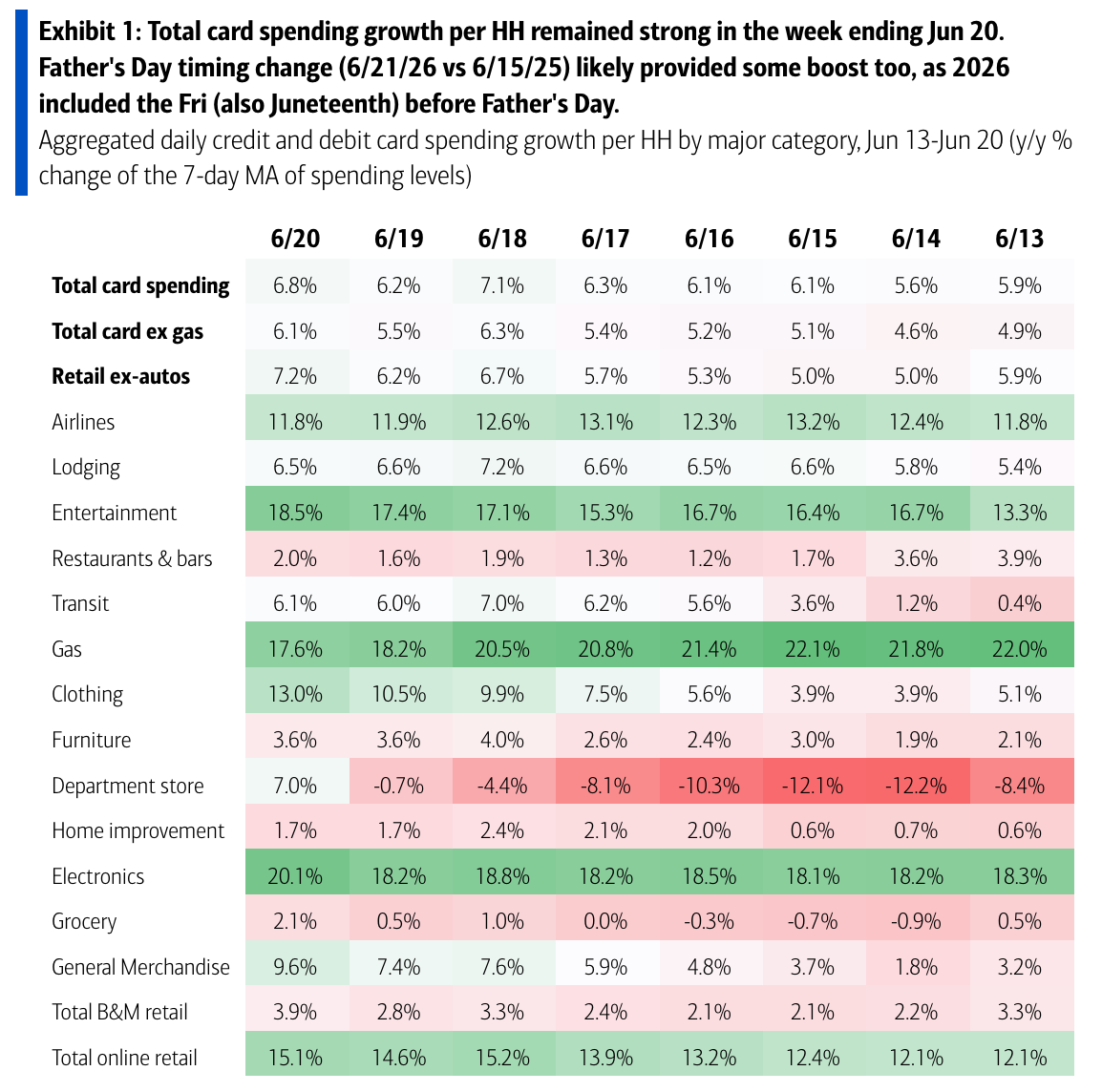
Consumer spending data has looked a lot better than consumer sentiment readings. For more on this contradiction, read: We’re taking that vacation whether we like it or not 🛫 and Household finances are both ‘worse’ and ‘good’ 🌦️
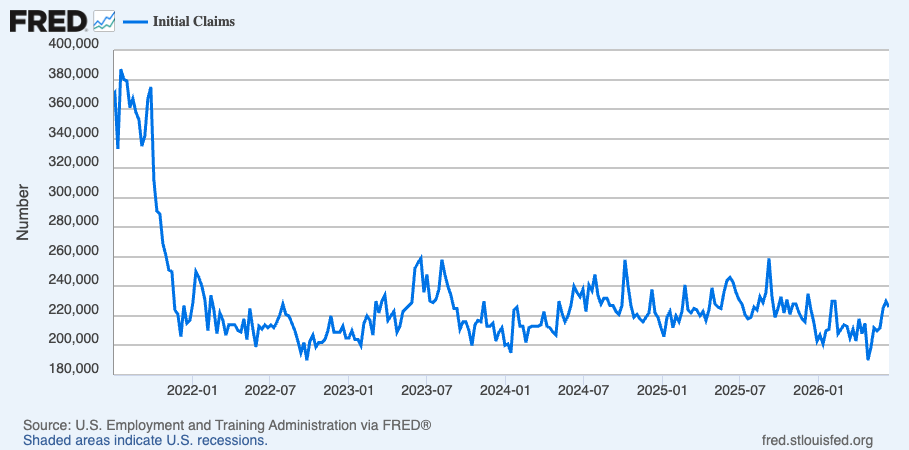
💼 New unemployment insurance claims, total ongoing claims remain low. Initial claims for unemployment benefits declined to 215,000 during the week ending June 20, down from 227,000 the week prior. This metric remains at levels historically associated with economic growth.
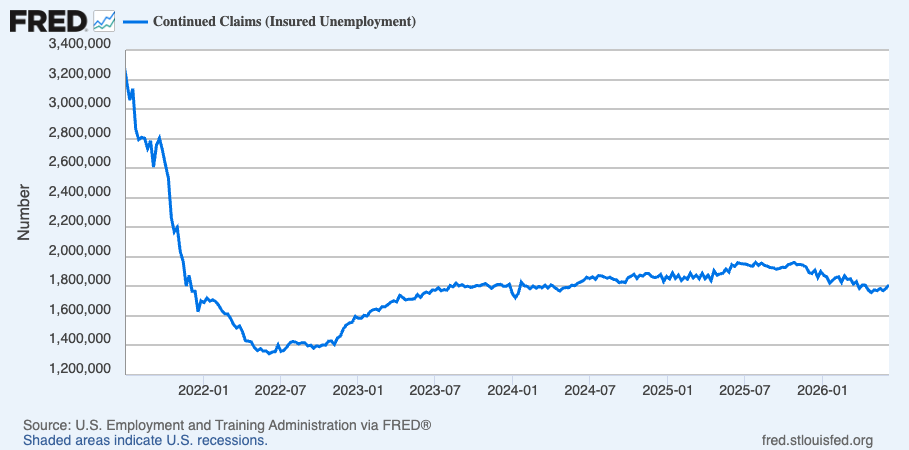
Insured unemployment, which captures those who continue to claim unemployment benefits, ticked up to 1.82 million during the week ending June 13.
For more on the labor market, read: Why mass tech layoffs have little effect on total employment 💾
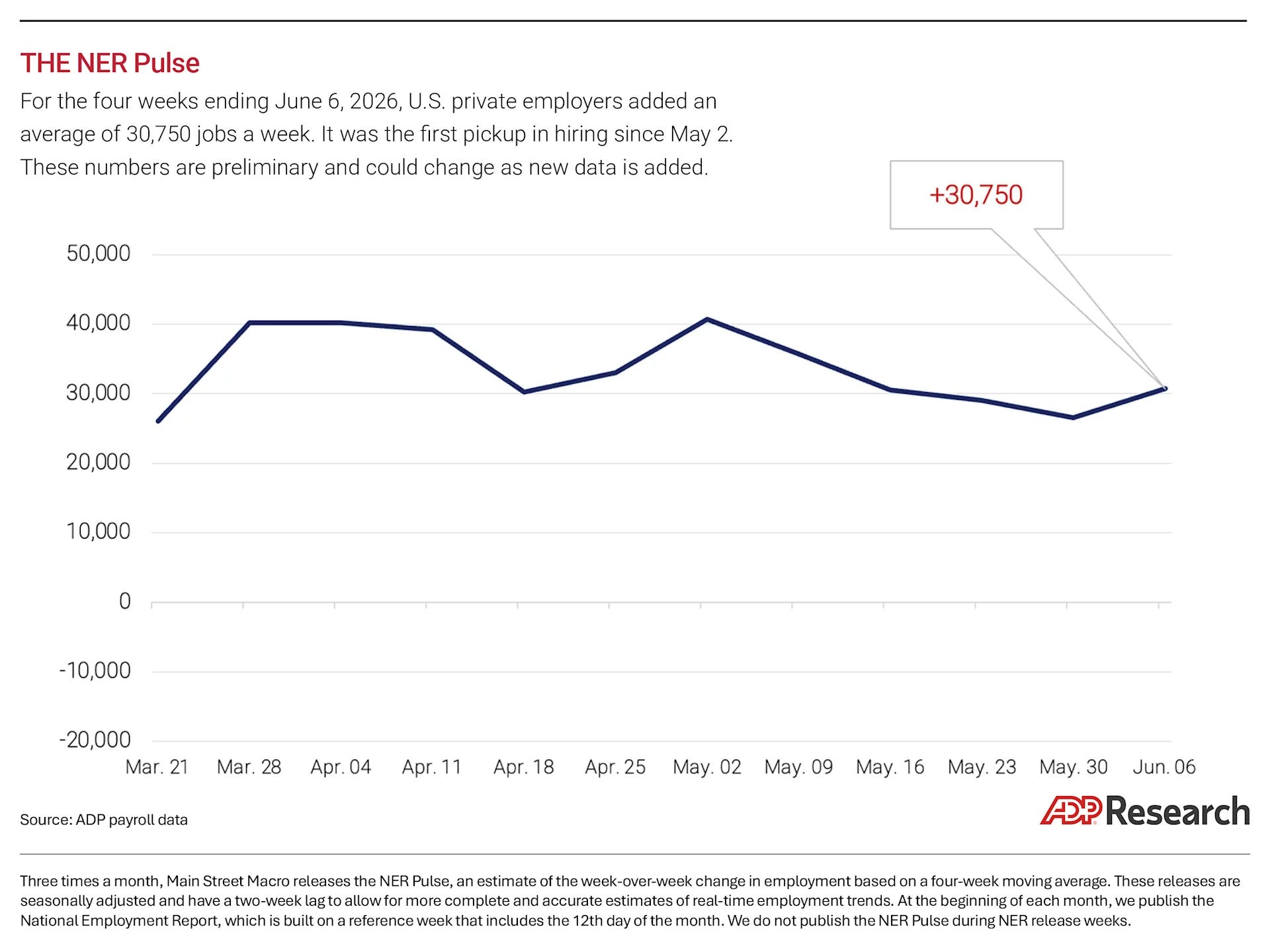
🤔 Recent private job growth is stable. According to payroll processor ADP, private U.S. employers added 30,750 jobs in the four weeks ending June 6.
For more on the labor market, read: Things are looking up in the labor market👍
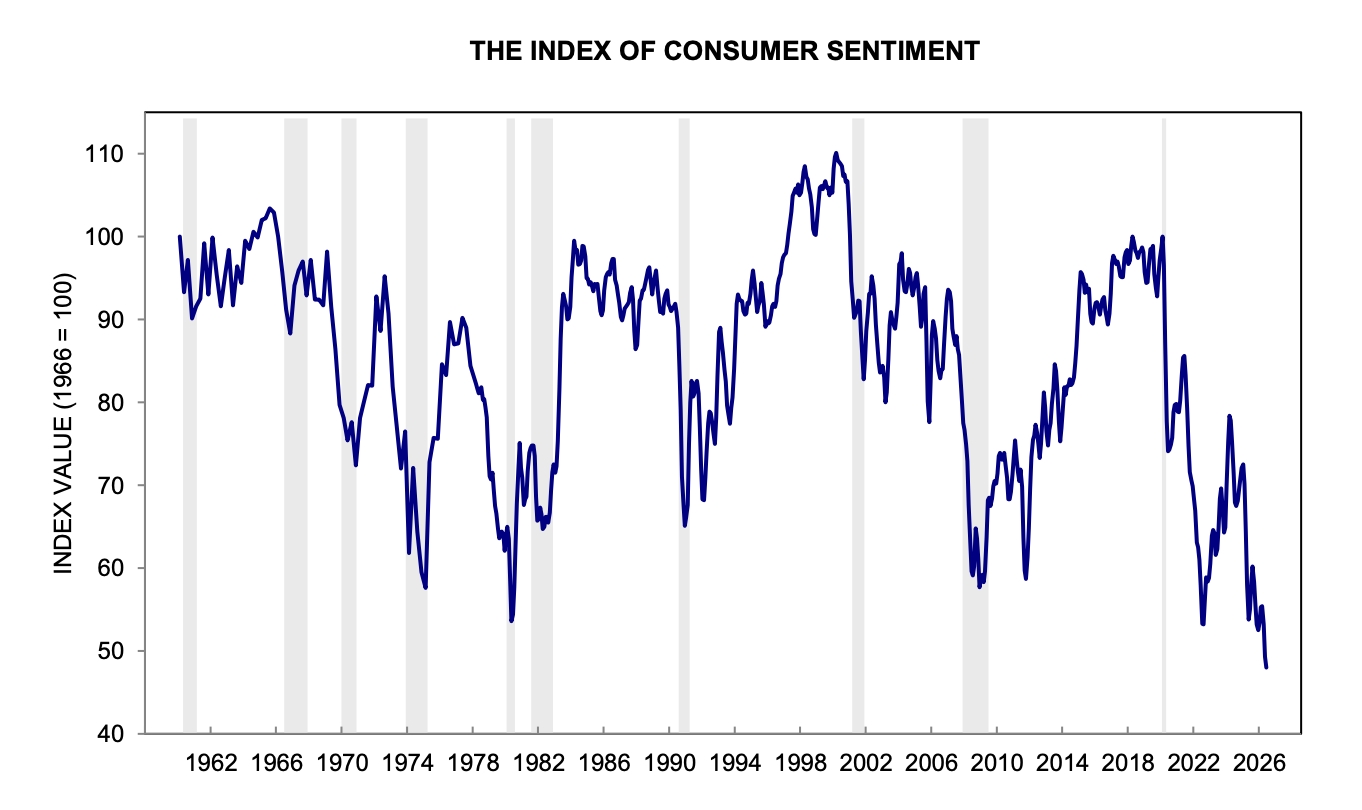
👎 Consumer vibes remain in the dump, but improve slightly. From the University of Michigan’s June Surveys of Consumers: “Consumer sentiment confirmed its early-month reading, rising about 10% above May as gas prices moderated. Increases were seen across income, wealth, and political affiliation. Expected business conditions over the next five years surged 16% as consumers’ worries over long-term consequences of the Iran conflict appear to be easing. Still, sentiment remains in unfavorable territory at 13% below the February 2026 reading prior to the start of the Iran conflict, and nearly 20% less than a year ago. The cost of living remains at the forefront of consumers’ minds; for the third straight month, over half of consumers spontaneously mentioned that high prices are weighing down their personal finances.”
For more on consumer sentiment, read: What consumers do > what consumers say 🙊
🏭 Business investment activity ticks lower. Orders for nondefense capital goods excluding aircraft — a.k.a. core capex or business investment — rose 1.6% to a record $84.0 billion in May.
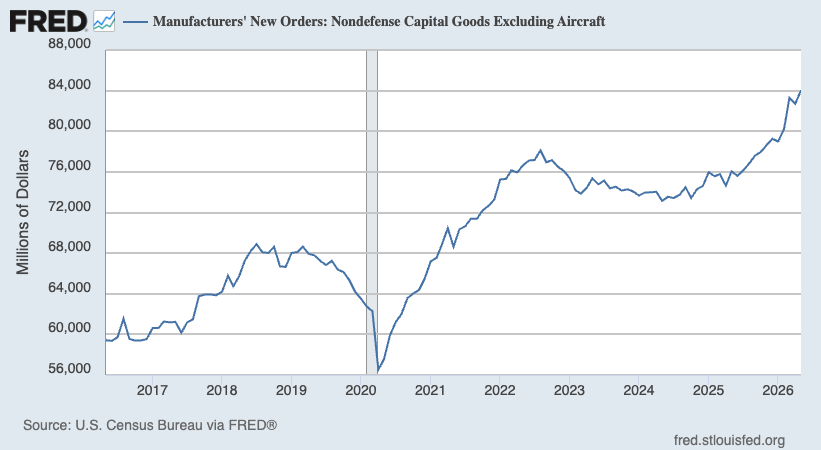
Core capex orders are a leading indicator, meaning they foretell economic activity down the road.
🏠 Mortgage rates tick higher. According to Freddie Mac, the average 30-year fixed-rate mortgage rose to 6.49%, up from 6.47% last week. From Freddie Mac: “Rates have remained relatively stable over the last six weeks. Meanwhile, purchase activity eased modestly and refinance activity has continued to pick up recently, reflecting borrowers’ responsiveness to current rate levels.“
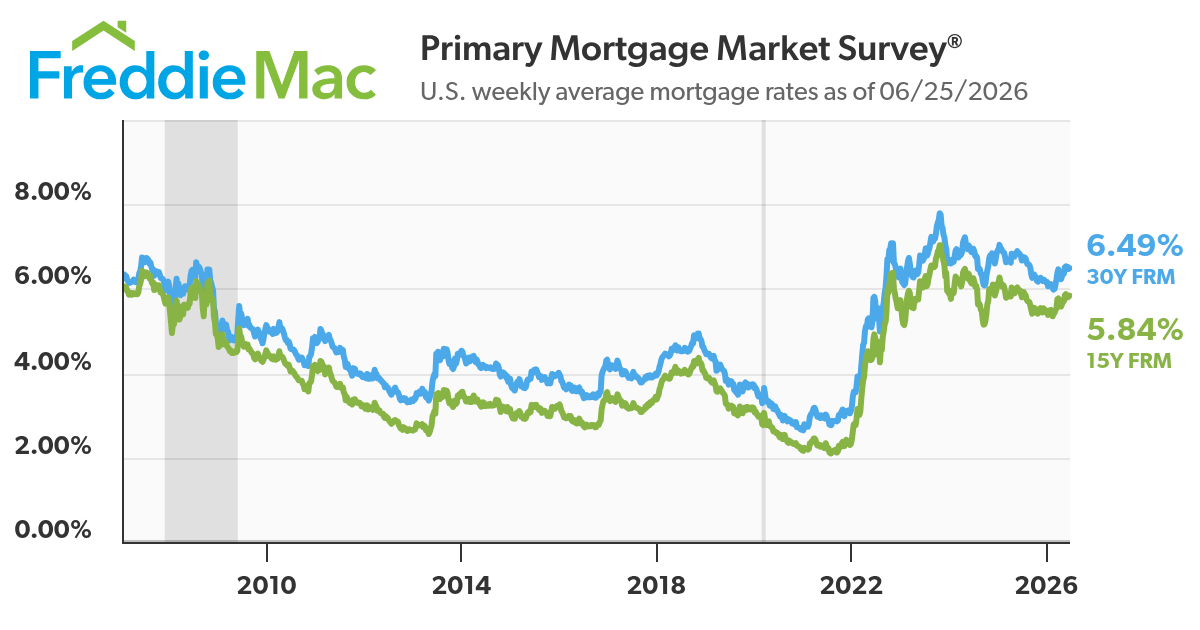
As of Q1, there were 147.6 million housing units in the U.S., of which 86.0 million were owner-occupied and about 40% were mortgage-free. Of those carrying mortgage debt, almost all have fixed-rate mortgages, and most of those mortgages have rates that were locked in before rates surged from 2021 lows. All of this is to say: Most homeowners are not particularly sensitive to the small weekly movements in home prices or mortgage rates.
For more on mortgages and home prices, read: Why home prices and rents are creating all sorts of confusion about inflation 😖
🏘️ New home sales fell. Sales of newly built homes declined 7.3% in May to an annualized rate of 580,000 units.
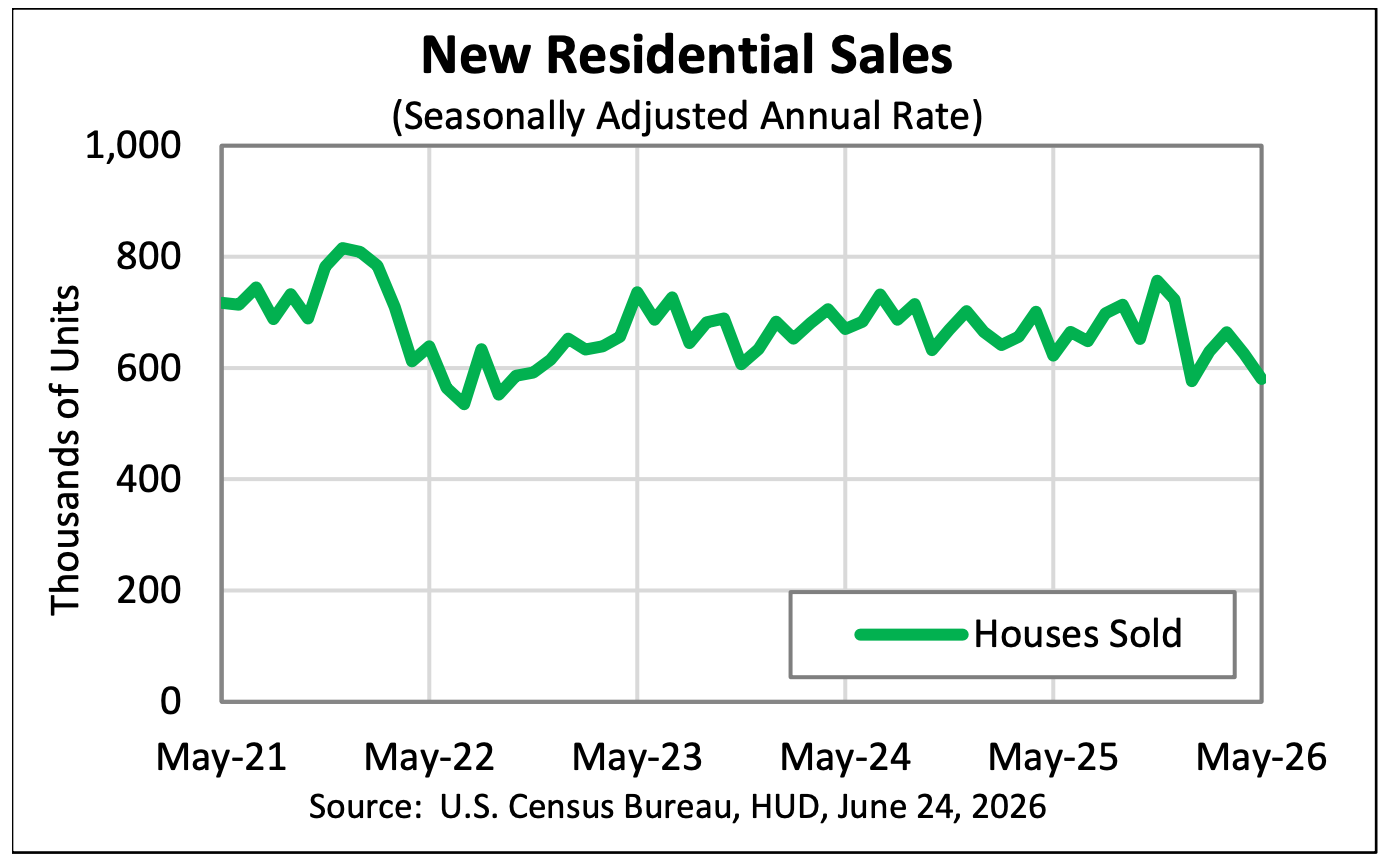
New home sales figures come with a large margin of error. For more on this, read: Mathematical context can totally change the story 🧮
🤔 Economic activity survey signals subdued growth. From S&P Global’s June U.S. Flash PMI: “Brighter news out of the Middle East has helped restore some confidence among US businesses in June, though the overall rate of economic growth signalled by the flash PMI survey remains relatively sluggish compared to that seen earlier in the year in the lead up to the conflict. The survey signals that current output levels are consistent with the economy struggling to grow much faster than a 1% annualized rate in the second quarter.”
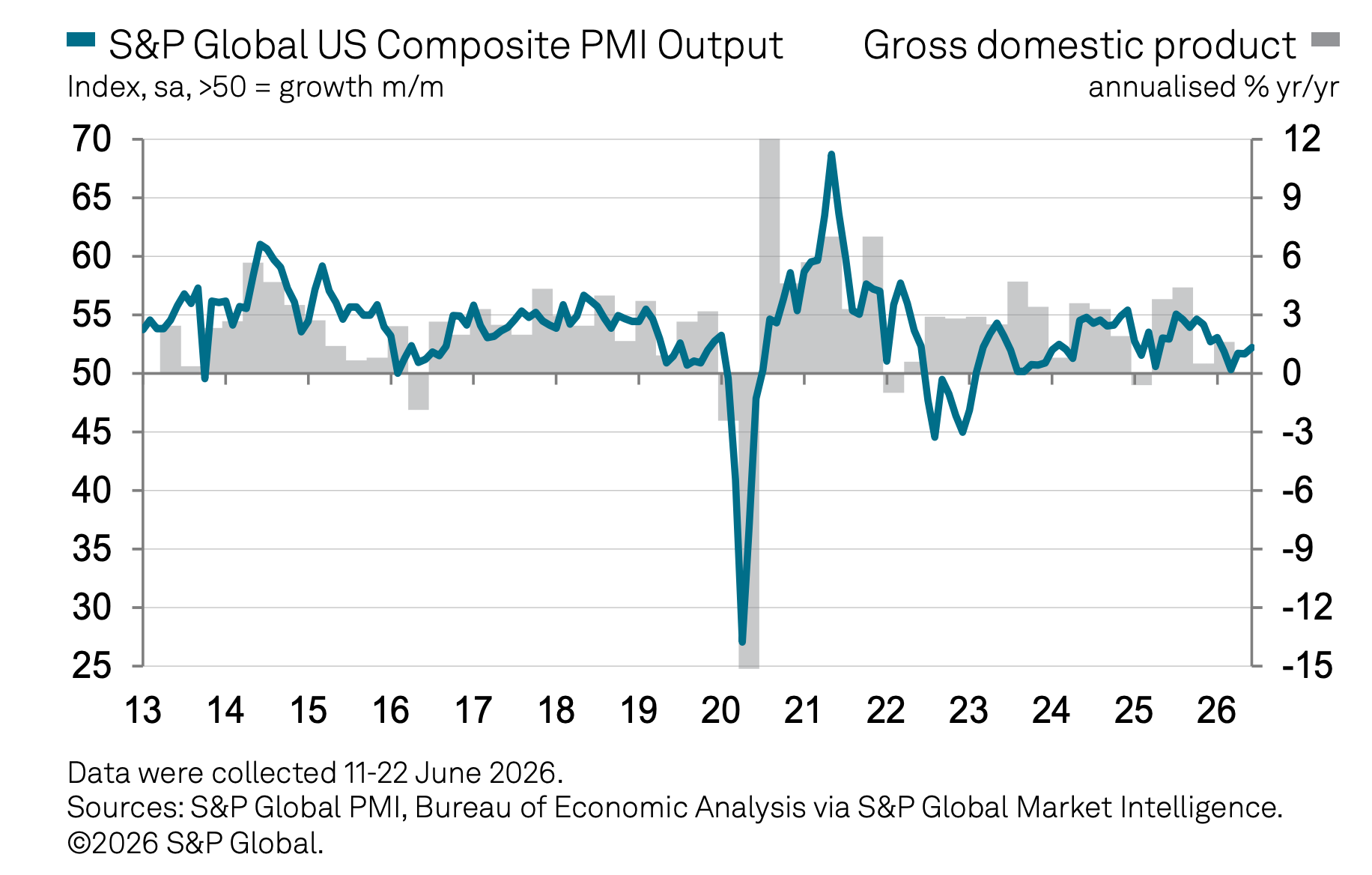
Keep in mind that during times of perceived stress, soft survey data tends to be more exaggerated than actual hard data.
For more on this, read: What businesses do > what businesses say 🙊 and 4 sometimes-conflicting ways I’m thinking about the economy 😬😞😎🙃
📈 Near-term GDP growth estimates are tracking positively. The Atlanta Fed’s GDPNow model sees real GDP growth rising at a 2.5% rate in Q2.
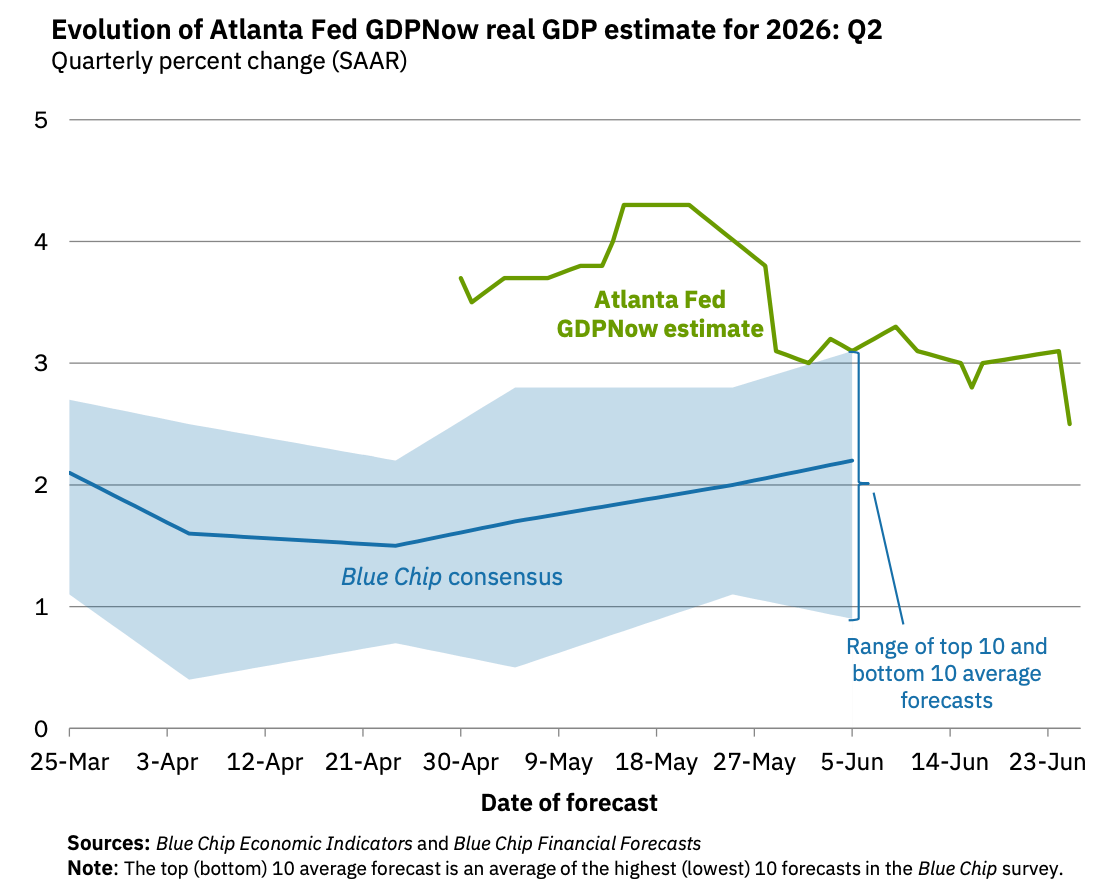
For more on GDP and the economy, read: It’s too ambiguous to just say ‘the economy’ 🤦🏻♂️ and Economic data can often be both ‘worse’ and ‘good’ 🌦️
Putting it all together 📋
Earnings look bullish: The long-term outlook for the stock market remains favorable, bolstered by expectations for years of earnings growth. And earnings are the most important driver of stock prices.
Demand is positive: Demand for goods and services remains positive, supported by healthy consumer and business balance sheets. Personal spending activity remains at record levels. Core capex orders, which are a leading indicator of business spending, have been trending higher.
Growth rates have cooled: While the economy remains healthy, growth has normalized from much hotter levels earlier in the cycle. The economy is less “coiled” these days as major tailwinds like job openings and excess savings have faded. Job creation, while positive, is not as hot as it used to be. It has become harder to argue that growth is destiny.
Actions speak louder than words: We are in an odd period, given that the hard economic data decoupled from the soft sentiment-oriented data. Consumer and business sentiment has been relatively poor, even as tangible consumer and business activity continues to grow and trend at record levels. From an investor’s perspective, what matters is that the hard economic data continues to hold up.
Stocks are not the economy: There’s a case to be made that the U.S. stock market could outperform the U.S. economy in the near term, thanks largely to positive operating leverage. Since the pandemic, companies have aggressively adjusted their cost structures. This came with strategic layoffs and investment in new equipment, including hardware powered by AI. These moves are resulting in positive operating leverage, which means a modest amount of sales growth — in the cooling economy — is translating to robust earnings growth.
Mind the ever-present risks: Of course, we should not get complacent. There will always be risks to worry about, such as U.S. political uncertainty, geopolitical turmoil, energy price volatility, and cyber attacks. There are also the dreaded unknowns. Any of these risks can flare up and spark short-term volatility in the markets.
Investing is never a smooth ride: There’s also the harsh reality that economic recessions and bear markets are developments that all long-term investors should expect as they build wealth in the markets. Always keep your stock market seat belts fastened.
Think long-term: For now, there’s no reason to believe there’ll be a challenge that the economy and the markets won’t overcome. The long game remains undefeated, and it’s a streak that long-term investors can expect to continue.
For more on how the macro story is evolving, check out the previous review of the macro crosscurrents. »
Key insights about the stock market 📈
Here’s a roundup of some of TKer’s most talked-about paid and free newsletters about the stock market. All of the headlines are hyperlinked to the archived pieces.
10 truths about the stock market 📈
The stock market can be an intimidating place: It’s real money on the line, there’s an overwhelming amount of information, and people have lost fortunes in it very quickly. But it’s also a place where thoughtful investors have long accumulated a lot of wealth. The primary difference between those two outlooks is related to misconceptions about the stock market that can lead people to make poor investment decisions.
The makeup of the S&P 500 is constantly changing 🔀
Passive investing is a concept usually associated with buying and holding a fund that tracks an index. And no passive investment strategy has attracted as much attention as buying an S&P 500 index fund. However, the S&P 500 — an index of 500 of the largest U.S. companies — is anything but a static set of 500 stocks.

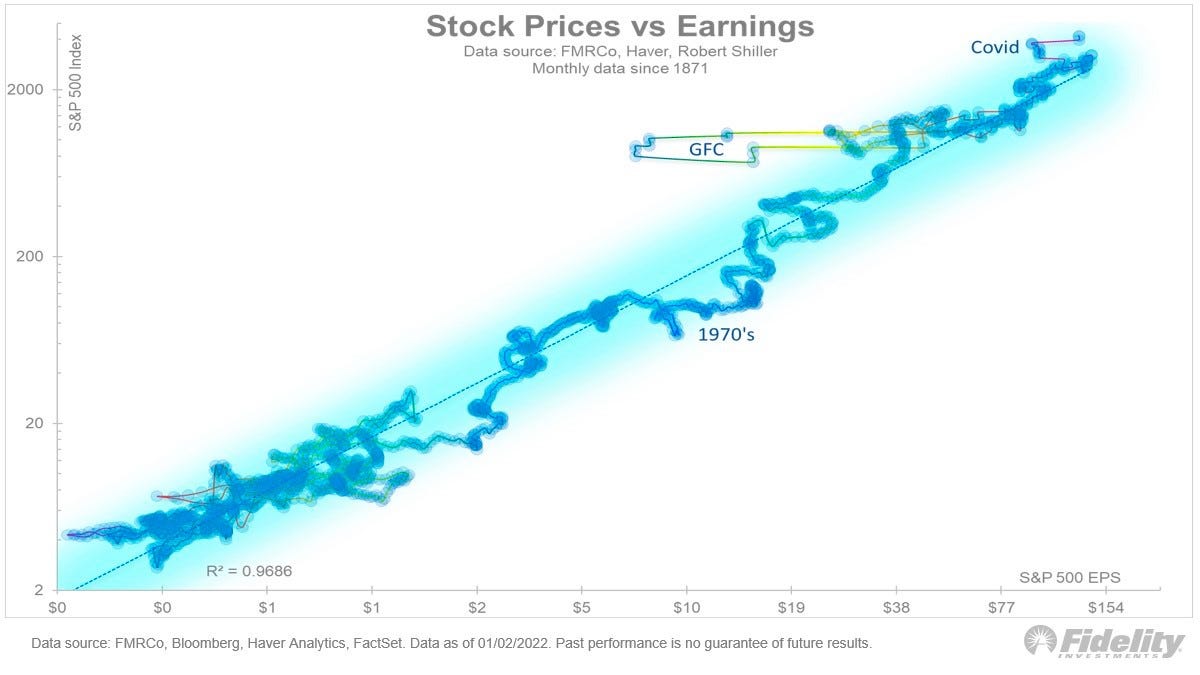
The key driver of stock prices: Earnings💰
For investors, anything you can ever learn about a company matters only if it also tells you something about earnings. That’s because long-term moves in a stock can ultimately be explained by the underlying company’s earnings, expectations for earnings, and uncertainty about those expectations for earnings. Over time, the relationship between stock prices and earnings has a very tight statistical relationship.
Stomach-churning stock market sell-offs are normal🎢
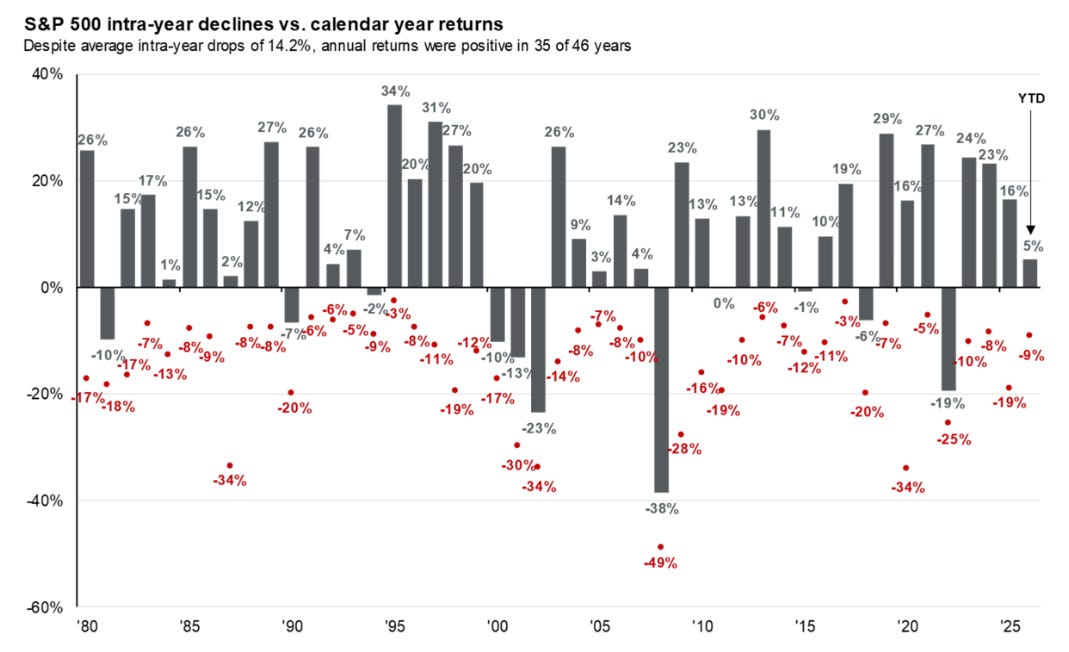
Investors should always be mentally prepared for some big sell-offs in the stock market. It’s part of the deal when you invest in an asset class that is sensitive to the constant flow of good and bad news. Since 1950, the S&P 500 has seen an average annual max drawdown (i.e., the biggest intra-year sell-off) of 14%.
How the stock market performed around recessions 📉📈
Every recession in history was different. And the range of stock performance around them varied greatly. There are two things worth noting. First, recessions have always been accompanied by a significant drawdown in stock prices. Second, the stock market bottomed and inflected upward long before recessions ended.

In the stock market, time pays ⏳
Since 1928, the S&P 500 has generated a positive total return more than 89% of the time over all five-year periods. Those are pretty good odds. When you extend the timeframe to 20 years, you’ll see that there’s never been a period where the S&P 500 didn’t generate a positive return.

What a strong dollar means for stocks 👑
While a strong dollar may be great news for Americans vacationing abroad and U.S. businesses importing goods from overseas, it’s a headwind for multinational U.S.-based corporations doing business in non-U.S. markets.

Stanley Druckenmiller’s No. 1 piece of advice for novice investors 🧐
…you don’t want to buy them when earnings are great, because what are they doing when their earnings are great? They go out and expand capacity. Three or four years later, there’s overcapacity and they’re losing money. What about when they’re losing money? Well, then they’ve stopped building capacity. So three or four years later, capacity will have shrunk and their profit margins will be way up. So, you always have to sort of imagine the world the way it’s going to be in 18 to 24 months as opposed to now. If you buy it now, you’re buying into every single fad every single moment. Whereas if you envision the future, you’re trying to imagine how that might be reflected differently in security prices.
Peter Lynch made a remarkably prescient market observation in 1994 🎯
Some event will come out of left field, and the market will go down, or the market will go up. Volatility will occur. Markets will continue to have these ups and downs. … Basic corporate profits have grown about 8% a year historically. So, corporate profits double about every nine years. The stock market ought to double about every nine years… The next 500 points, the next 600 points — I don’t know which way they’ll go… They’ll double again in eight or nine years after that. Because profits go up 8% a year, and stocks will follow. That’s all there is to it.
Warren Buffett’s ‘fourth law of motion’ 📉
Long ago, Sir Isaac Newton gave us three laws of motion, which were the work of genius. But Sir Isaac’s talents didn’t extend to investing: He lost a bundle in the South Sea Bubble, explaining later, “I can calculate the movement of the stars, but not the madness of men.” If he had not been traumatized by this loss, Sir Isaac might well have gone on to discover the Fourth Law of Motion: For investors as a whole, returns decrease as motion increases.
Most pros can’t beat the market 🥊
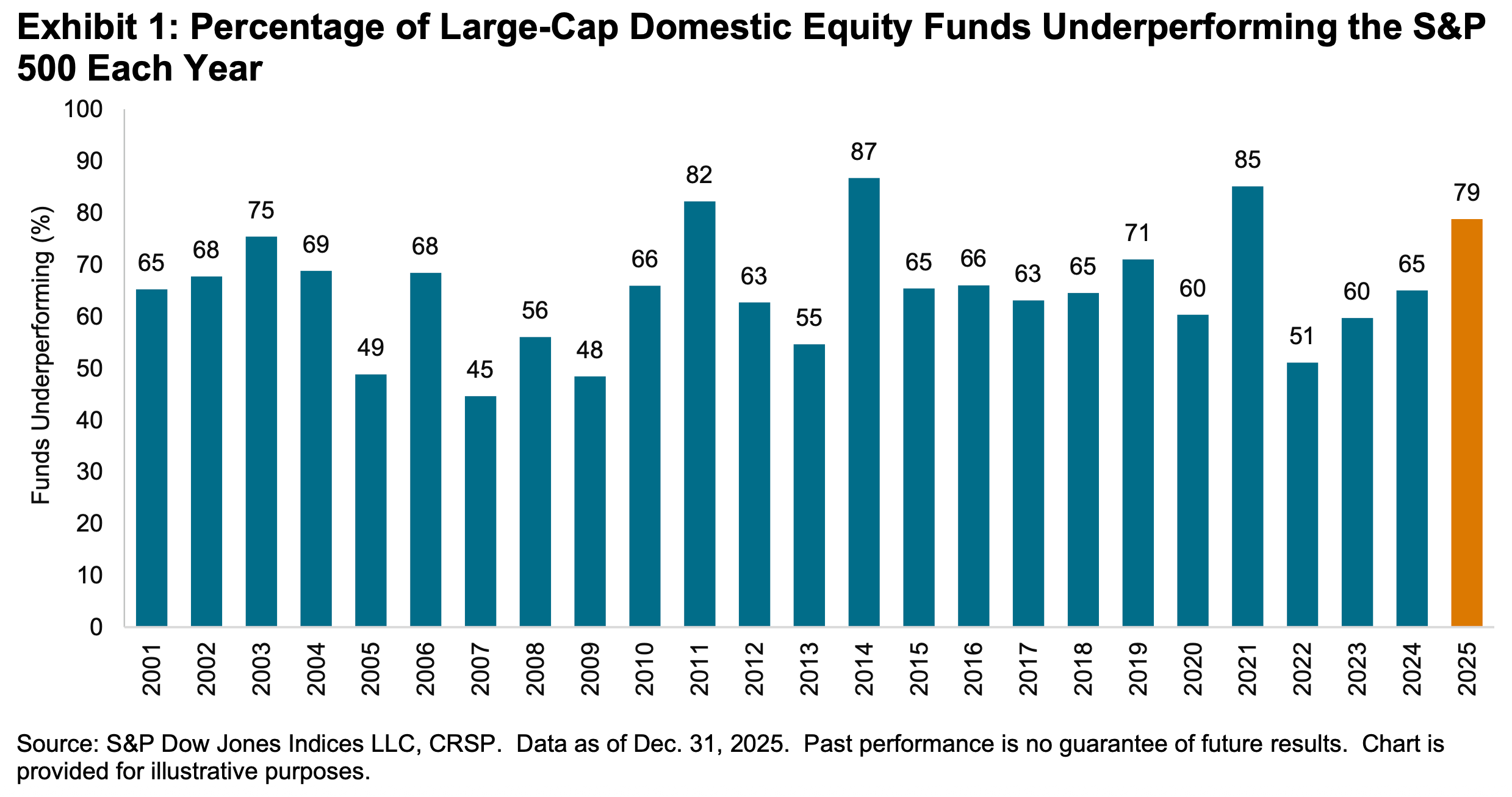
According to S&P Dow Jones Indices (SPDJI), 79% of U.S. large-cap equity fund managers underperformed the S&P 500 in 2025. As you stretch the time horizon, the numbers get even more dismal. Over three years, 67% underperformed. Over 5 years, 89% underperformed. And over 20 years, 93% underperformed. This 2025 performance was the 16th consecutive year in which the majority of fund managers in this category have lagged the index.
Proof that ‘past performance is no guarantee of future results’ 📊
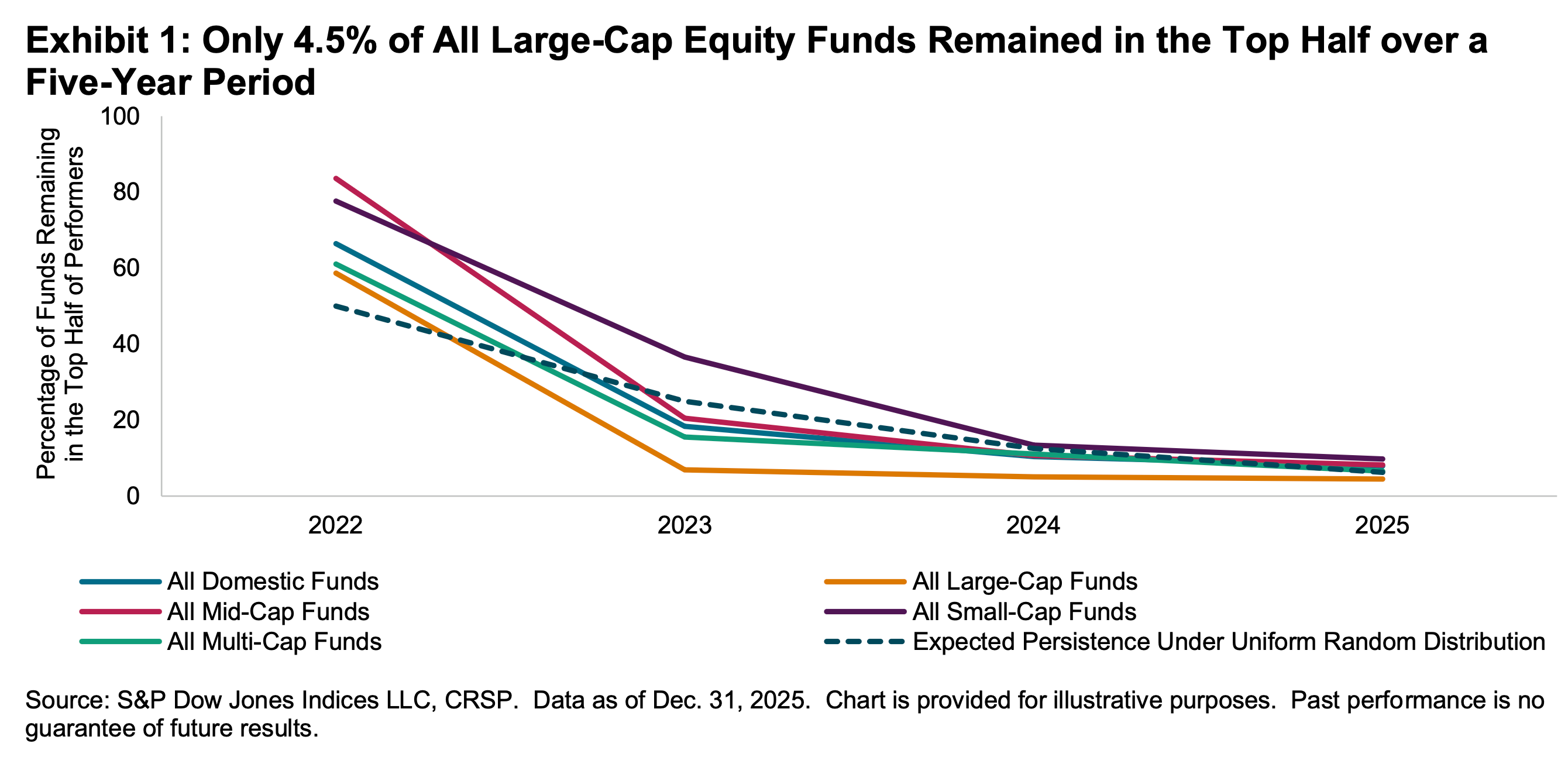
Even if you are a fund manager who generated industry-leading returns in one year, history says it’s an almost insurmountable task to stay on top consistently in subsequent years. According to S&P Dow Jones Indices, of the 334 large-cap equity funds in the top half of performance in 2021, 58.7% remained at the top half in 2022. However, just 6.9% remained on top through 2023. Only 4.5% stayed on top in the five consecutive years through 2025.
It’s much more dismal when you raise the bar. Of the 164 large-cap equity funds in the top quartile in 2021, just 20.1% remained in that category in 2022. That percentage fell to literally 0.0% in 2023.
The odds are stacked against stock pickers 🎲
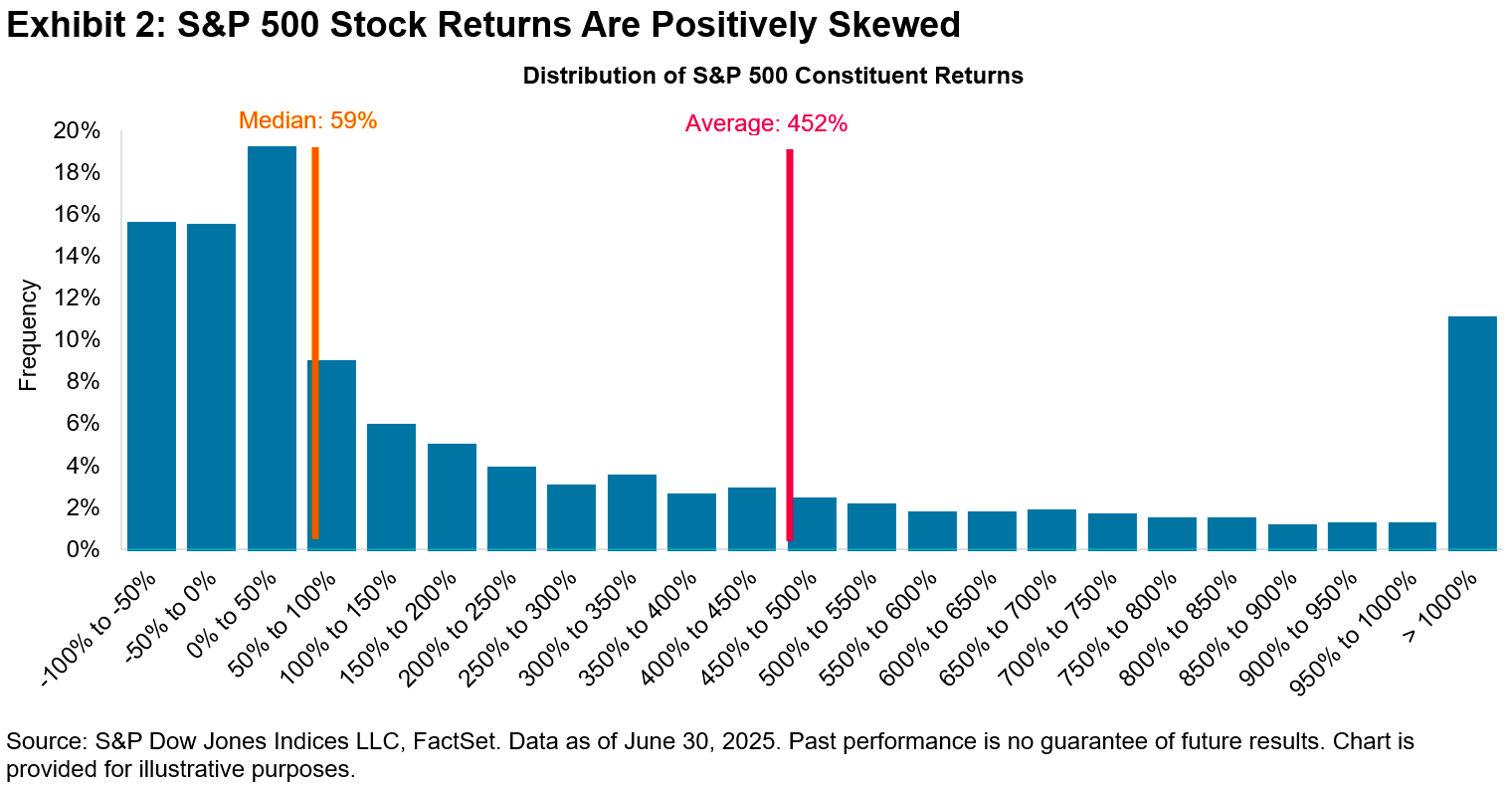
Picking stocks in an attempt to beat market averages is an incredibly challenging and sometimes money-losing effort. Most professional stock pickers aren’t able to do this consistently. One of the reasons for this is that most stocks don’t deliver above-average returns. According to S&P Dow Jones Indices, only 19% of the stocks in the S&P 500 outperformed the average stock’s return from 2001 to 2025. Over this period, the average return on an S&P 500 stock was 452%, while the median stock rose by just 59%.