What comes after the bubble could be electrifying ⚡️
Plus a charted review of the macro crosscurrents 🔀
📈The stock market rallied to all-time highs, with the S&P 500 setting an intraday high of 7,002.28 on Wednesday and a closing high of 6,978.60 on Tuesday. The index ended the week at 6,939.03 and is now up 1.4% year-to-date. For market insights, check out the Stock Market tab at TKer. »
-
If AI is all it’s cracked up to be, the winners in the stock market should extend far beyond the large-cap tech hyperscalers currently building the AI infrastructure.
As BofA’s Savita Subramanian wrote back in June 2023: “The larger benefit may be had by old-economy, inefficient companies that can increase earnings power more permanently from efficiency and productivity gains.”
It’s too early to say conclusively, but the market may be in the process of getting in front of this phase of the AI narrative, as small-cap stocks have recently been outperforming large-cap stocks.
As Wells Fargo’s Ohsung Kwon argues, small-cap stocks (as tracked by the Russell 2000, or RTY) could see a bigger tailwind from AI than large-cap stocks (as tracked by the S&P 500 or SPY).
“We see signs that small caps have been slower to adopt AI than large caps,” Kwon wrote on Monday. “We believe the next leg of AI adoption is in small caps — the longer-term bull case for RTY. We estimate every 1% labor cost saving translates to a ~2% EPS boost for SPX, but >6% for RTY.”
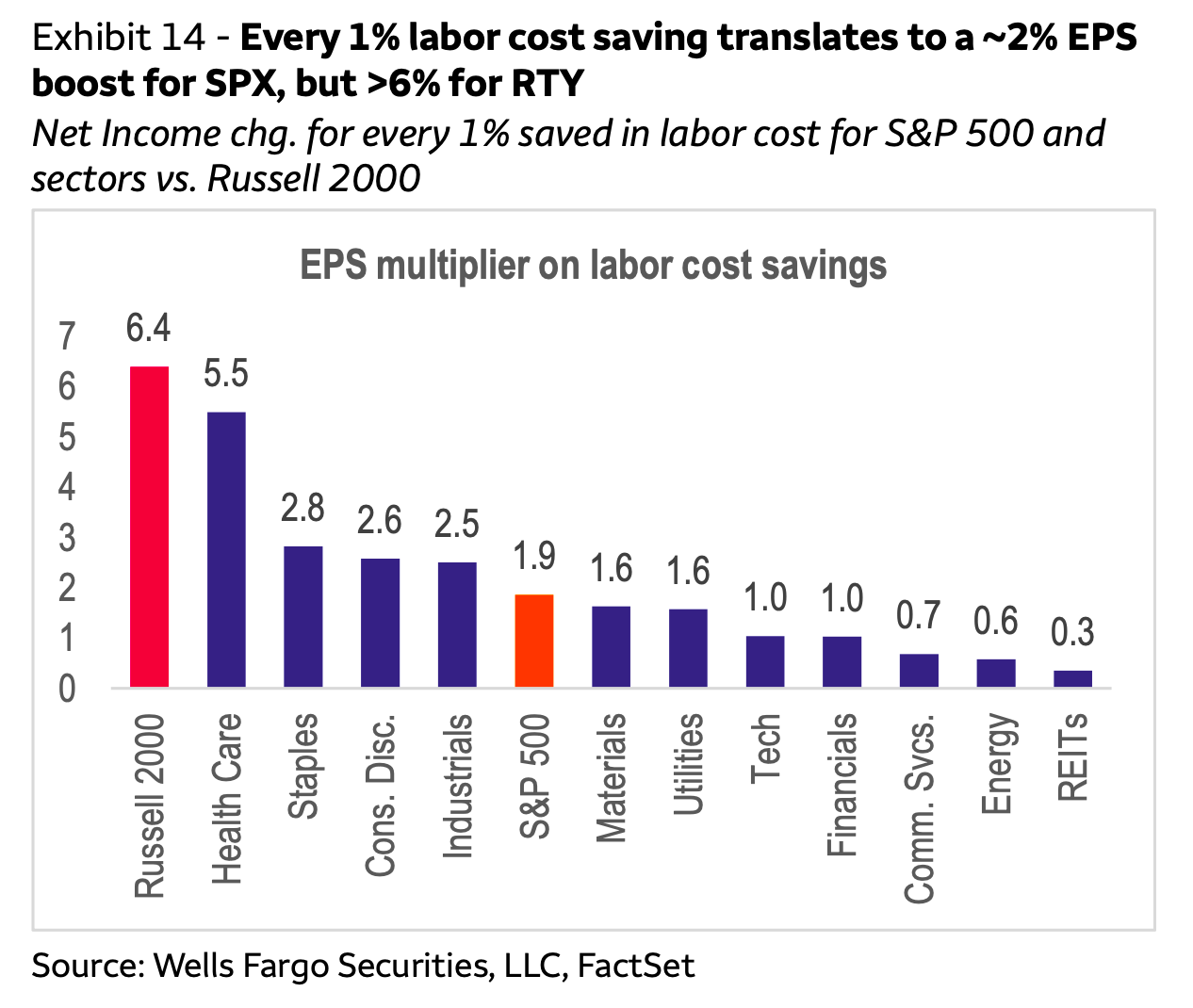
This is what makes the promise of AI truly exciting for investors: The beneficiaries aren’t limited to those developing the technology. Companies across industries have been exploring AI applications, and many are already implementing them in their operations.
It could take years to see the benefits ⏳
To be clear, we’re still in the early innings of the AI era, and it’ll take time before we better understand the actual impact on productivity across sectors.
But if costs indeed come down materially and productivity improves beyond just tech companies, it would be consistent with past technological revolutions.
In a recent research note, Bridgewater’s Greg Jensen drew parallels between AI today and electrification in the 1920s and the internet boom of the late 1990s.
“At least in the near term, AI seems likely to follow the classic J-curve productivity path of prior general-purpose technologies like electricity or the internet—requiring a lot of upfront investment that doesn’t immediately improve productivity, but eventually proving transformative,” he wrote.

As you can see in the charts, it took years for the economy to realize the productivity booms promised by electricity and the internet.
“We believe AI capex is set to significantly support U.S. growth in the coming years and that many of the second-order consequences of this investment are not priced in,“ he added.
Read Jensen’s whole note here.
Looking beyond the bubble for second-and-third-order effects 🫧
Carlyle Group’s Jason Thomas took a closer look at those historical experiences. And he wasn’t shy about addressing head-on the risk that we may be in a bubble like we were in 1929 and 2000. In fact, the title of his note is: “Bubbles as a Feature, Not a Bug.“
“Financial markets tend to be very good at spotting technological revolutions but have rarely proven able to anticipate their second-and-third-order effects,” Thomas wrote. “Bubbles deflate not because the technology disappoints, but because so much of its economics flow downstream to the companies that employ it and the new industries it spawns.”
He discussed the decades-long process of harnessing and deploying electricity from the 1880s to the 1920s. “The earnings and valuations of electric holding companies and equipment manufacturers both tripled; between 1925 and 1929, industry-wide annualized returns exceeded 50%.”
Those companies weren’t able to sidestep the crash of 1929. But what followed is notable.
“Electrified factories drove down manufacturers’ production costs and electrified homes stimulated demand for their products, like refrigerators, vacuums, and radios,” Thomas observed. “This is where far more of electrification’s economic value ultimately accrued, with 11% annualized returns on the stocks of durable goods manufacturers over a decade stretching through the depths of the Great Depression.”

Thomas noted that after the dotcom bubble burst in 2000, businesses leveraging the internet similarly outperformed in the wake of the market crash.
“These same phenomena repeated themselves in the internet boom of the late 1990s,” he wrote. “Real capex grew at a 24% annualized rate as investors focused on bandwidth, router architecture, and processing power bottlenecks. But the economic value of that IT and telecom hardware manifested downstream. Networked computing allowed manufacturers and retailers to exploit new sales channels, more precisely calibrate production and inventories to sales, and streamline logistics networks and supply chains.

“A technology doesn’t need to fizzle for its bubble to deflate,” Thomas continued. “Likewise, those inclined to focus on ‘irrationality’ or ‘market euphoria’ miss how bubbles seem a natural outgrowth of epochal shifts. If the market didn’t misjudge the importance of hardware bottlenecks and first-mover advantages, who’d be willing to fund the research and infrastructure that ultimately makes the technological revolution, and value downstream from it, possible?”
Read Thomas’ whole note here.
Zooming out 🔭
As we’ve discussed before, history is riddled with examples of game-changing technologies leading to overinvestment followed by market corrections.
Unfortunately, it’s not easy to predict when those corrections will happen and what they will look like.
But the bottom line is that investors should be mindful of the risk that the hot stocks most directly exposed to the AI capex boom are at risk of falling behind.
In fact, this may already be happening.
On Wednesday, Deutsche Bank’s Jim Reid shared this chart of where the various AI-exposed stocks were trading relative to their all-time highs — as the S&P 500 itself was climbing to new heights.

“What’s striking about the [S&P 500’s] move back to the peak, though, is how much leadership has shifted over the past quarter,” Reid wrote.
By the way, this dynamic is a reminder that it’s possible for the overall market to move higher even as its leaders fall behind.
-
Related from TKer:
27 charts to consider as we look forward in the stock market 📊📉📈
How do I think of today’s AI craze relative to past bubbles? 🫧🤖🚂🚗
It’s not bearish when the stock market’s leaders fall behind 🔀
🎲🎰 See me in Las Vegas!
I’ll be leading a breakout session at The MoneyShow TradersExpo in Las Vegas. The conference runs from Feb. 23 to 25. Sign up here!
Review of the macro crosscurrents 🔀
There were several notable data points and macroeconomic developments since our last review:
🏛️ Fed holds rates. On Wednesday, the Federal Reserve kept its benchmark interest rate target range at 3.5% to 3.75%.

From the Fed’s policy statement: “Available indicators suggest that economic activity has been expanding at a solid pace. Job gains have remained low, and the unemployment rate has shown some signs of stabilization. Inflation remains somewhat elevated.”

For more on what Fed policy could mean for markets, read: About Fed rate cuts and stocks ⚖️
👎 Consumer vibes are in the dumps. The Conference Board’s Consumer Confidence Index fell 9.7 points in January. From the report: “Confidence collapsed in January, as consumer concerns about both the present situation and expectations for the future deepened. All five components of the Index deteriorated, driving the overall Index to its lowest level since May 2014 (82.2)—surpassing its COVID-19 pandemic depths.”

More from the report: “Confidence among all generations trended downward in the month, but Gen Z remained the most optimistic of all generations surveyed. By income, confidence on a six-month moving average basis ticked downward for all brackets, and consumers earning less than $15K remained the least optimistic among all income groups. Consumer confidence continued to fade in January among all political affiliations, with the sharpest decline among Independents.”
Relatively weak consumer sentiment readings appear to contradict relatively strong consumer spending data. For more on this contradiction, read: What consumers do > what consumers say 🙊 and We’re taking that vacation whether we like it or not 🛫
👎 Consumers don’t feel good about the labor market. From The Conference Board: “Consumers’ views of the labor market were also weaker in January. 23.9% of consumers said jobs were ‘plentiful,’ down from 27.5% in December. 20.8% of consumers said jobs were ‘hard to get,’ up from 19.1%.”
Many economists monitor the spread between these two percentages (a.k.a., the labor market differential). The direction of the spread reflects a cooling labor market.
More from The Conference Board: “Consumers were also more concerned about the labor market outlook in January. 13.9% of consumers expected more jobs to be available, down from 17.4% in December. 28.5% anticipated fewer jobs, up from 26.0%.”
👎 Job growth has been lackluster. According to payroll processor ADP, private U.S. employers added 7,750 jobs in the four weeks ending Jan. 4.

For more on what the private data providers are saying about jobs, read: The unofficial jobs data is unambiguously discouraging 💼
💼 New unemployment insurance claims remain low, total ongoing claims decline. Initial claims for unemployment benefits declined marginally to 209,000 during the week ending Jan. 24, down from 210,000 the week prior. This metric remains at levels historically associated with economic growth.

Insured unemployment, which captures those who continue to claim unemployment benefits, declined to 1.827 million during the week ending Jan. 17.

For more on the labor market, read: The next couple of years for the job market could be tough 🫤
💪 Labor productivity increases. From the BLS: “Nonfarm business sector labor productivity increased 4.9% in the third quarter of 2025 … as output increased 5.4% and hours worked increased 0.5%. (All quarterly percent changes in this release are seasonally adjusted annualized rates.) From the same quarter a year ago, nonfarm business sector labor productivity increased 1.9% in the third quarter of 2025.”

For more, read: Promising signs for productivity ⚙️ and The crummy labor market is yielding a ‘tenure dividend’ for corporations 💰
💳 Card spending data is holding up. From JPMorgan: “As of 23 Jan 2026, our Chase Consumer Card spending data (unadjusted) was 8.0% above the same day last year. Based on the Chase Consumer Card data through 23 Jan 2026, our estimate of the US Census December control measure of retail sales m/m is 0.51%.”
From BofA: “Total card spending per HH was up 6.6% y/y in the week ending Jan 24, according to BAC aggregated credit & debit card data. Y/y spending growth surged in groceries, HI & general merchandise, indicative of stocking up before Winter Storm Fern. Total card spending growth was also softer in the large unaffected states of CA & FL than the rest of the US.“
Consumer spending data has looked a lot better than consumer sentiment readings. For more on this contradiction, read: We’re taking that vacation whether we like it or not 🛫 and Consumer finances remain in good shape 💵
⛽️ Gas prices tick higher, but remain relatively low. From AAA: “The winter storm that wreaked havoc on most of the nation has led to supply disruptions and pushed up the national average for a gallon of regular gasoline to $2.87. Below-freezing temperatures and lingering snow have disrupted some crude production and refinery operations, while gasoline demand increased pre-storm as drivers filled up their tanks ahead of the severe winter weather. Those factors have led to a rise at the pump over the last week but not enough to match last year’s national average at this time of $3.12.”

For more on energy prices, read: Higher oil prices meant something different in the past 🛢️
🏭 Business investment activity improves. Orders for nondefense capital goods excluding aircraft — a.k.a. core capex or business investment — increased 0.4% to a record $78.24 billion in November.

Core capex orders are a leading indicator, meaning they foretell economic activity down the road.
For more on the major macro metrics, read: We’re at an economic tipping point ⚖️
🏠 Home prices cool. According to the S&P CoreLogic Case-Shiller index, home prices were up 1.4% year-over-year in November but declined 0.1% month-over-month. From S&P Dow Jones Indices’ Nicholas Godec: “Monthly price changes were mixed but leaned negative in November, underscoring persistent softness. On a non-seasonally adjusted basis, 15 of the 20 major metro areas saw prices decline from October (versus 16 declines in the previous month). Only a handful of markets – including Los Angeles, San Diego, Miami, New York, and Phoenix – eked out slight gains before seasonal adjustment. After accounting for typical seasonal slowing, the National Index inched up just 0.4% for the month, indicating that price momentum remains muted.”

🏠 Mortgage rates tick higher. According to Freddie Mac, the average 30-year fixed-rate mortgage rose to 6.10%, up from 6.09% last week: “With the economy improving and the average 30-year fixed-rate mortgage nearly a percentage point lower than last year, more homebuyers are entering the market. Buyers always should shop around for the best rate, as multiple quotes can potentially save them thousands.”

As of Q3, there were 148.3 million housing units in the U.S., of which 86.9 million were owner-occupied and about 40% were mortgage-free. Of those carrying mortgage debt, almost all have fixed-rate mortgages, and most of those mortgages have rates that were locked in before rates surged from 2021 lows. All of this is to say: Most homeowners are not particularly sensitive to the small weekly movements in home prices or mortgage rates.

For more on mortgages and home prices, read: Why home prices and rents are creating all sorts of confusion about inflation 😖
📈 Near-term GDP growth estimates are tracking positively. The Atlanta Fed’s GDPNow model sees real GDP growth rising at a 4.2% rate in Q4.

For more on GDP and the economy, read: 9 once-hot economic charts that cooled 📉 and We’re at an economic tipping point ⚖️
Putting it all together 📋
Earnings look bullish: The long-term outlook for the stock market remains favorable, bolstered by expectations for years of earnings growth. And earnings are the most important driver of stock prices.
Demand is positive: Demand for goods and services remains positive, supported by healthy consumer and business balance sheets. Job creation, although cooling, appears to be modestly positive, and the Federal Reserve — having resolved the inflation crisis — shifted its focus toward supporting the labor market.
But growth is cooling: While the economy remains healthy, growth has normalized from much hotter levels earlier in the cycle. The economy is less “coiled” these days as major tailwinds like excess job openings and core capex orders have faded. It has become harder to argue that growth is destiny.
Actions speak louder than words: We are in an odd period, given that the hard economic data decoupled from the soft sentiment-oriented data. Consumer and business sentiment has been relatively poor, even as tangible consumer and business activity continues to grow and trend at record levels. From an investor’s perspective, what matters is that the hard economic data continues to hold up.
Stocks are not the economy: There’s a case to be made that the U.S. stock market could outperform the U.S. economy in the near term, thanks largely to positive operating leverage. Since the pandemic, companies have aggressively adjusted their cost structures. This came with strategic layoffs and investment in new equipment, including hardware powered by AI. These moves are resulting in positive operating leverage, which means a modest amount of sales growth — in the cooling economy — is translating to robust earnings growth.
Mind the ever-present risks: Of course, we should not get complacent. There will always be risks to worry about, such as U.S. political uncertainty, geopolitical turmoil, energy price volatility, and cyber attacks. There are also the dreaded unknowns. Any of these risks can flare up and spark short-term volatility in the markets.
Investing is never a smooth ride: There’s also the harsh reality that economic recessions and bear markets are developments that all long-term investors should expect as they build wealth in the markets. Always keep your stock market seat belts fastened.
Think long-term: For now, there’s no reason to believe there’ll be a challenge that the economy and the markets won’t overcome. The long game remains undefeated, and it’s a streak that long-term investors can expect to continue.
For more on how the macro story is evolving, check out the previous review of the macro crosscurrents. »
Key insights about the stock market 📈
Here’s a roundup of some of TKer’s most talked-about paid and free newsletters about the stock market. All of the headlines are hyperlinked to the archived pieces.
10 truths about the stock market 📈
The stock market can be an intimidating place: It’s real money on the line, there’s an overwhelming amount of information, and people have lost fortunes in it very quickly. But it’s also a place where thoughtful investors have long accumulated a lot of wealth. The primary difference between those two outlooks is related to misconceptions about the stock market that can lead people to make poor investment decisions.
The makeup of the S&P 500 is constantly changing 🔀
Passive investing is a concept usually associated with buying and holding a fund that tracks an index. And no passive investment strategy has attracted as much attention as buying an S&P 500 index fund. However, the S&P 500 — an index of 500 of the largest U.S. companies — is anything but a static set of 500 stocks.

The key driver of stock prices: Earnings💰
For investors, anything you can ever learn about a company matters only if it also tells you something about earnings. That’s because long-term moves in a stock can ultimately be explained by the underlying company’s earnings, expectations for earnings, and uncertainty about those expectations for earnings. Over time, the relationship between stock prices and earnings has a very tight statistical relationship.

Stomach-churning stock market sell-offs are normal🎢
Investors should always be mentally prepared for some big sell-offs in the stock market. It’s part of the deal when you invest in an asset class that is sensitive to the constant flow of good and bad news. Since 1950, the S&P 500 has seen an average annual max drawdown (i.e., the biggest intra-year sell-off) of 14%.
How the stock market performed around recessions 📉📈
Every recession in history was different. And the range of stock performance around them varied greatly. There are two things worth noting. First, recessions have always been accompanied by a significant drawdown in stock prices. Second, the stock market bottomed and inflected upward long before recessions ended.

In the stock market, time pays ⏳
Since 1928, the S&P 500 has generated a positive total return more than 89% of the time over all five-year periods. Those are pretty good odds. When you extend the timeframe to 20 years, you’ll see that there’s never been a period where the S&P 500 didn’t generate a positive return.

What a strong dollar means for stocks 👑
While a strong dollar may be great news for Americans vacationing abroad and U.S. businesses importing goods from overseas, it’s a headwind for multinational U.S.-based corporations doing business in non-U.S. markets.

Stanley Druckenmiller's No. 1 piece of advice for novice investors 🧐
…you don't want to buy them when earnings are great, because what are they doing when their earnings are great? They go out and expand capacity. Three or four years later, there's overcapacity and they're losing money. What about when they're losing money? Well, then they’ve stopped building capacity. So three or four years later, capacity will have shrunk and their profit margins will be way up. So, you always have to sort of imagine the world the way it's going to be in 18 to 24 months as opposed to now. If you buy it now, you're buying into every single fad every single moment. Whereas if you envision the future, you're trying to imagine how that might be reflected differently in security prices.
Peter Lynch made a remarkably prescient market observation in 1994 🎯
Some event will come out of left field, and the market will go down, or the market will go up. Volatility will occur. Markets will continue to have these ups and downs. … Basic corporate profits have grown about 8% a year historically. So, corporate profits double about every nine years. The stock market ought to double about every nine years… The next 500 points, the next 600 points — I don’t know which way they’ll go… They’ll double again in eight or nine years after that. Because profits go up 8% a year, and stocks will follow. That's all there is to it.
Warren Buffett's 'fourth law of motion' 📉
Long ago, Sir Isaac Newton gave us three laws of motion, which were the work of genius. But Sir Isaac’s talents didn’t extend to investing: He lost a bundle in the South Sea Bubble, explaining later, “I can calculate the movement of the stars, but not the madness of men.” If he had not been traumatized by this loss, Sir Isaac might well have gone on to discover the Fourth Law of Motion: For investors as a whole, returns decrease as motion increases.
Most pros can’t beat the market 🥊
According to S&P Dow Jones Indices (SPDJI), 65% of U.S. large-cap equity fund managers underperformed the S&P 500 in 2024. As you stretch the time horizon, the numbers get even more dismal. Over three years, 85% underperformed. Over 10 years, 90% underperformed. And over 20 years, 92% underperformed. This 2023 performance follows 14 consecutive years in which the majority of fund managers in this category have lagged the index.

Proof that 'past performance is no guarantee of future results' 📊
Even if you are a fund manager who generated industry-leading returns in one year, history says it’s an almost insurmountable task to stay on top consistently in subsequent years. According to S&P Dow Jones Indices, just 4.21% of all U.S. equity funds in the top half of performance during the first year were able to remain in the top during the four subsequent years. Only 2.42% of U.S. large-cap funds remained in the top half
SPDJI’s report also considered fund performance relative to their benchmarks over the past three years. Of 738 U.S. large-cap equity funds tracked by SPDJI, 50.68% beat the S&P 500 in 2022. Just 5.08% beat the S&P in the two years ending 2023. And only 2.14% of the funds beat the index over the three years ending in 2024.

The odds are stacked against stock pickers 🎲
Picking stocks in an attempt to beat market averages is an incredibly challenging and sometimes money-losing effort. Most professional stock pickers aren’t able to do this consistently. One of the reasons for this is that most stocks don’t deliver above-average returns. According to S&P Dow Jones Indices, only 19% of the stocks in the S&P 500 outperformed the average stock’s return from 2001 to 2025. Over this period, the average return on an S&P 500 stock was 452%, while the median stock rose by just 59%.


